Scissor Lift Pivot Pins and Bushings: Functions, Wear, and Maintenance
Published
Category
Guide
Pivot pins and bushings carry every raise on a scissor lift. Learn the four wear mechanisms, the pry-bar play test, and when to replace bushing or pin.
Every raise and lower on a scissor lift passes through a handful of steel pins and the bushings wrapped around them. They are among the cheapest parts on the machine, and among the first to be ignored.
The cost of ignoring them is not the price of a bushing. It is platform sway that operators start compensating for, a stack that descends unevenly, and in the worst case a cracked pin boss that turns a maintenance item into a structural repair.
What follows is the judgement around the parts: what the joints do, how they wear, what you can catch by hand, and when to replace the bushing alone. Torque values, clearance limits and intervals stay with the manufacturer's manual.
What Pivot Pins and Bushings Do
The load path through the scissor stack
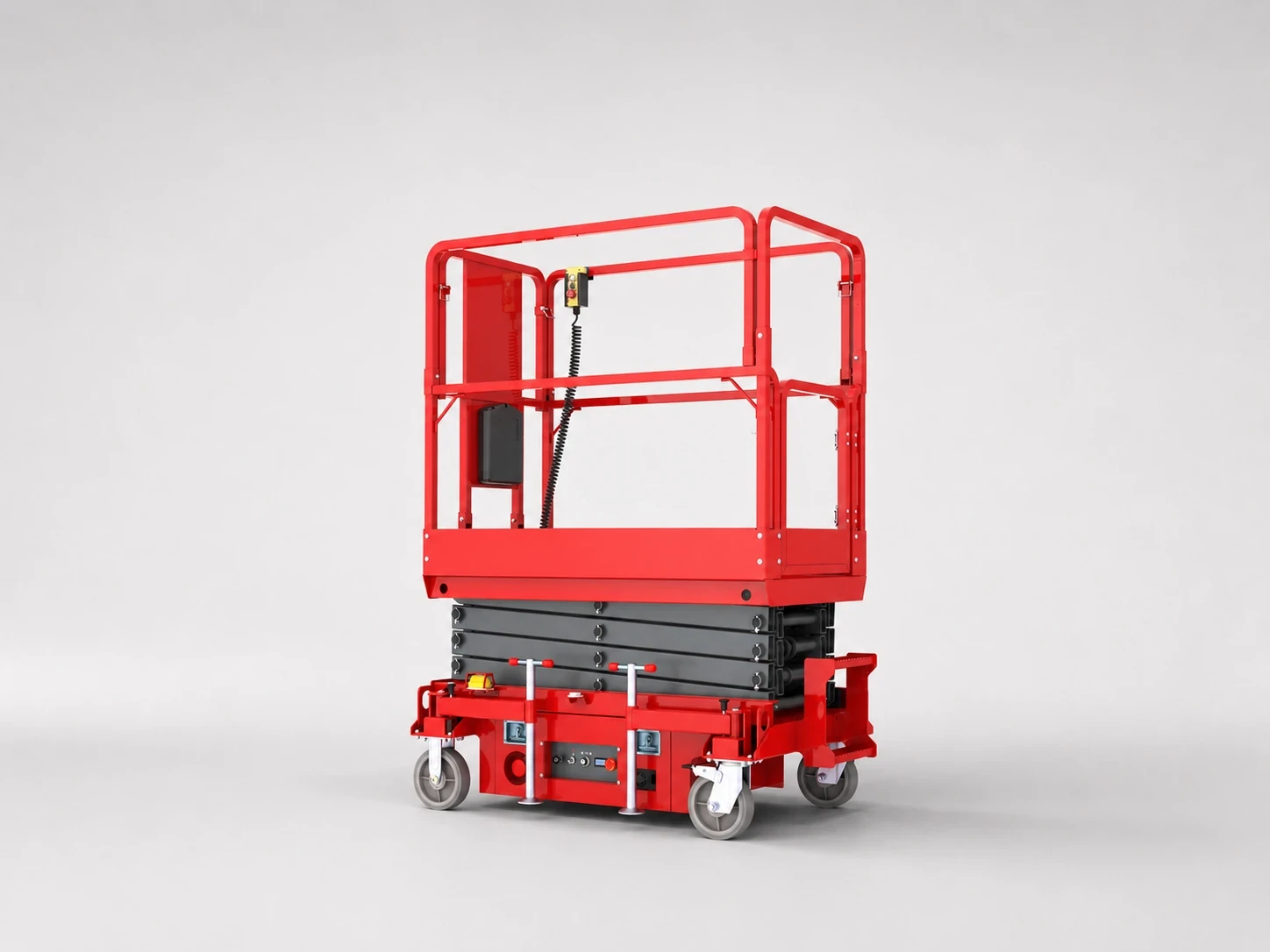
Platform load travels down through the deck into the upper arm pair, then alternates arm to arm through the pivot pins until it reaches the chassis. Each pin sits in double shear and carries both vertical load and the horizontal thrust that appears as the stack opens.
The joints are not static connections. Every raise cycles each pin through a small rotation, and the number of joints scales with the number of stack stages — which is why different scissor lift types carry different inspection loads even at similar heights.
Why the bushing, not the pin, is the wear part
The bushing is deliberately softer than the pin and designed to be replaced. That is the point of the arrangement: a sacrificial sleeve costs a fraction of an arm assembly and presses out in a workshop.
So a worn bushing is normal, and a worn pin is a symptom. Once the pin is stepped or scored, the joint ran with excess clearance long enough to damage the harder part. The arm and pin interface is covered in our breakdown of scissor lift mechanism and components.

The Main Wear Mechanisms
Four mechanisms account for almost all pivot wear, and each leaves a different signature.
Mechanism | Cause | Signature on the part |
|---|---|---|
Abrasive | Grit, sand, wash-down chemical | Polished rings, scoring, dirty grease |
Fretting | Oscillation without full rotation | Dark oxide stain, fine pitting in one spot |
Starvation | Missed greasing, blocked fitting, failed seal | Dry bore, heat bluing on the pin |
Overload | Excess load, dropped deck, impact | Ovality, wall thinning, cracked boss |
Abrasive wear from grit and wash-down
Outdoor and wash-down sites are the worst case. Grit reaches the bore, mixes with grease and turns the bushing into a lapping tool. Damage is progressive and quiet until clearance opens.
Fretting when the joint stops moving
A machine working at one height for weeks barely rotates its pins. The joint still moves by micrometres under load, which is enough to fret the surface and start pitting.
Lubrication starvation
A blocked fitting looks identical to a working one from outside. The joint fails from the inside, and the first external sign is usually heat or noise rather than visible damage.
Overload and shock loading
Rated load is a distributed figure. Material stacked at one end, or a deck dropped onto its stops, loads a single joint far beyond its share — the load capacity and point loading limits are what the pin actually sees.
Symptoms You Can Catch Without Instruments
Failing joints usually announce themselves long before they fail — though several of these symptoms also match electrical faults, which the five common electric scissor lift problems separate.
Symptom | Most likely cause | First action |
|---|---|---|
Deck feels loose at height | Accumulated clearance across joints | Pry test each joint, compare neighbours |
Jerky raise, uneven descent | Binding joint or control fault | Rule out controls, then check play |
Creak at mid-height | Dry joint | Grease and re-check after a shift |
Crack at a pin boss | Structural, not maintenance | Stop use, assess before restart |
Platform sway and stack slop
Operators describe the deck as feeling loose at height. It is clearance accumulated across several joints, and it usually shows first in the joints carrying the most load, not those nearest the deck.
Jerky raise, uneven descent
Rule out the control before blaming the pivots; control handle functions and operating modes explain how descent is commanded and what a fault looks like.
Creaking, knocking, and where to listen
Creaks at mid-height are usually dry joints. A knock on reversal is clearance. Listening at the base joints while the stack moves locates the source faster than listening at the deck.
Cracks at the pin bosses
This is the one that matters. A crack radiating from a boss is a structural finding, not a maintenance item, and the machine comes out of service until it is assessed.
Inspection: What to Check and How
Visual checks with the stack stowed
Stowed, the joints are accessible and the upper pins are unloaded. Look for grease weep, rust streaks, missing fittings and deformation at the boss.
Checking play with a pry bar
Lift the arm slightly against the pin and watch for movement between arm and bushing. Compare joints on the same machine — one that moves noticeably more than its neighbours is the one to open.
Grease fittings and seal condition
Pump each fitting and confirm grease exits at the joint rather than at the fitting. A failed seal lets water in, which is worse than no grease at all.
Worn pin versus worn bushing
A worn bushing shows an oval bore, thinning wall and score marks. A worn pin shows a step where it sat, flats from fretting, or bluing from heat. They are repaired differently. The pre-shift items that catch this early match the ones in OSHA inspection requirements, and on taller stacks the size chart dimensions tell you which joints need a platform rather than a kneel.

Maintenance and Replacement
Lubrication practice
Grease type and interval come from the manual and change with environment: a wash-down site needs a different regime from a dry warehouse. What matters more than the interval is that every fitting is actually fed, including those behind the stack.
Bushing only, or pin as well
If the pin is round, unstepped and within the manual's wear limit, replace the bushing alone. If it is stepped, scored or heat-discoloured, replace both — a new bushing on a damaged pin wears out in a fraction of its expected life.
Alignment and reaming
A pin driven in with a hammer looks seated and is not. It distorts the bushing, closes the grease path and starts the next failure immediately. Press or draw the pin in, and ream only where the manual specifies.
Locking hardware and re-torque
Retaining bolts, snap rings and lock plates are part of the joint. Reusing a deformed lock plate is a common reason a pin walks out; torque values belong to the manual, but checking them after the first shift belongs to the workshop.
Safety and Downtime
Never work under an unsupported stack
A hydraulic system is not a support. Any pin or bushing work requires the stack mechanically blocked and the machine isolated, which is why joint work is planned rather than improvised.
Planning the repair window
Bushing replacement is a workshop job with a predictable window; pin and boss work can become a structural repair. Checking play during the scheduled maintenance checks is what keeps the first case from becoming the second.
Frequently Asked Questions
How often should pivot bushings be replaced?
Replace on measured wear or on symptoms — excess play, sway at height, or a bushing that will not hold grease — not on a fixed calendar interval.
Can I replace just the bushing and keep the pin?
Yes, if the pin is round, free of steps and within the manual's wear limit. If it shows a step where it sat in the bore, replace both.
What causes a pin to wear faster than its bushing?
Usually contamination or a seized joint: grit in the bore, a blocked grease path, or a bushing that has spun and stopped acting as the sacrificial surface.
Is platform sway always a pivot problem?
No. It can come from worn bushings, loose locking hardware, a bent arm or chassis issues. Checking play joint by joint tells you whether the pivots are the source.
Can I grease a scissor lift with the platform raised?
Follow the manual. Where fittings are only reachable with the stack raised, the machine must be mechanically blocked, never held on hydraulics alone.
What does fretting look like on a pin?
Dark oxide staining and fine pitting at one spot, usually where the pin sat under load without full rotation. It resembles rust but does not spread like rust.
Do all scissor lifts use the same bushing type?
No. Bronze, composite and steel-backed PTFE bushings all appear, and each has its own lubrication and wear behaviour. Order by part number, not by dimension.
When should a cracked pin boss stop the machine?
Immediately. A crack at a boss is a structural finding; take the machine out of service and have it assessed by a competent person before further use.