Scissor Lift Size Chart: Dimensions, Platform Heights, and Working Heights
Published
Category
Small Scissor Lift
Explore a scissor lift size chart covering machine dimensions, platform heights, and working heights. Compare sizes and choose the right scissor lift for your application.
Scissor Lift Size Chart: Dimensions, Platform Heights, and Working Heights
Choosing the right scissor lift size involves more than checking how high the platform can rise. Buyers must also consider machine width, overall length, stowed height, platform dimensions, load capacity, and the clearance available at the worksite.
A scissor lift that provides sufficient working height may still be unsuitable if it cannot pass through a warehouse doorway, fit inside a freight elevator, or maneuver through narrow aisles. Similarly, a compact machine may fit the work area but provide insufficient platform space for operators, tools, and materials.
This guide explains how to read a scissor lift size chart, compare common machine dimensions, understand platform height versus working height, and select the appropriate equipment for warehouses, factories, construction sites, and facility maintenance.
Scissor Lift Size Chart: Dimensions and Heights
Scissor lift dimensions vary by model, lifting mechanism, rated capacity, and intended application. Compact electric models typically prioritize maneuverability and indoor access, while larger models provide higher platforms and more working space.
The following chart uses published WIZPLUSLIFT specifications to illustrate several size ranges and configurations.
Scissor Lift Series | Maximum Working Height | Maximum Platform Height | Overall Length | Overall Width | Overall Height |
|---|---|---|---|---|---|
5,000–6,800 mm | 3,000–4,800 mm | 1,410–1,430 mm, including pedals | 760 mm | 1,880–2,040 mm | |
5,000–6,800 mm | 3,000–4,800 mm | 1,410–1,430 mm, including pedals | 670–810 mm | 1,780–1,950 mm | |
7,800 mm | 5,800 mm | 1,840 mm, including pedals | 810 mm | 2,140 mm | |
8,000–15,800 mm | 5,800–13,800 mm | 1,910–2,650 mm, including pedals | 780–1,320 mm | 2,170–2,560 mm |
Important: Ranges represent different models or configurations within a product series. They do not describe one machine that combines the smallest dimensions with the maximum listed working height. Confirm the exact model's current datasheet before ordering.
The overall height column refers to the machine in its standard configuration. Where guardrails can be folded or removed for transport, the resulting height may differ. The manufacturer should confirm the permissible transport configuration.

What Do Scissor Lift Dimensions Mean?
Understanding the measurements in a scissor lift size chart helps buyers compare equipment correctly and avoid access problems.
Overall Width
Overall width is the maximum side-to-side dimension of the machine. It is an important specification for narrow warehouse aisles, industrial corridors, doorways, and elevator openings.
For example, the WIZPLUS CKJC-EH series has a published overall width of 760 mm. A narrow chassis may help the machine navigate confined indoor areas, but the required clearance must still account for steering, obstacles, and the actual route.
Before selecting a machine, measure the narrowest part of the travel path rather than relying only on the nominal aisle width.
Overall Length
Overall length measures the machine from front to rear. Depending on the manufacturer, the specification may include protruding pedals or other components.
The CKJC-EH series has an overall length of 1,410–1,430 mm with pedals and 1,280 mm without them. These figures illustrate why buyers should check how length is measured.
Overall length affects storage, loading, elevator access, and the space needed to turn or reposition the lift. A machine that fits through a doorway in a straight line may still require additional room to turn inside the building.
Overall Height and Stowed Height
Overall height describes the machine's vertical dimension in a specified configuration. Stowed height refers to the machine's height when the platform is lowered, although the exact measurement convention should be confirmed with the manufacturer.
For indoor equipment, this measurement is especially important when passing beneath overhead obstructions or entering a freight elevator.
Some models have folding or removable guardrails that reduce transport height. For example, the CKJC-7858EH has a published overall height of 2,140 mm, 1,770 mm with guardrails folded, and 1,300 mm with guardrails removed.
These figures should not be interpreted as permission to remove or fold guardrails during operation. Follow the manufacturer's instructions for transport and use.
Platform Length and Width
Platform dimensions determine how much usable floor space operators have for positioning themselves and carrying permitted tools or materials.
A larger platform can be helpful for maintenance teams working with equipment, installation components, and hand tools. However, larger platforms may increase the overall dimensions of the machine and affect access through confined spaces.
The CKJC-EH and CKJC-Y series list a platform measuring 1,280 × 700 mm. The CKJC-7858EH has a platform measuring 1,670 × 740 mm and a published extension-table length of 900 mm.
Check whether the listed platform dimensions refer to the main platform or include an extension. Also confirm any separate load limit for an extension platform.

Platform Height vs. Working Height: What's the Difference?
Platform height and working height are two different measurements. Confusing them is a common equipment-selection mistake.
Platform height is the vertical distance from the ground to the work platform when it is elevated.
Working height is the stated height at which an operator can typically perform work. Manufacturers commonly estimate this measurement by adding an assumed operator's reach to platform height. The assumed reach can vary, so buyers should check the manufacturer's definition.
For example, a scissor lift with a maximum platform height of 4.8 m may have a published working height of 6.8 m. This does not mean that the platform itself rises to 6.8 m.
Use the manufacturer's rated working height when making initial comparisons, but verify the actual required platform position for the task.
How to Calculate the Required Height
Use the following process to establish the height your equipment needs to reach:
Measure the target work area. Determine the height of the lighting fixture, ceiling component, cable tray, pipework, or other object that requires access.
Determine the operator's working position. Consider where the operator must stand to complete the task without leaning dangerously or overreaching.
Identify the required platform height. Account for the height of the target, the operator's position, and any practical working limitations.
Compare manufacturer-rated specifications. Check the working height and platform height for the exact model.
Allow for the actual site conditions. Confirm overhead obstructions, floor conditions, and any restrictions on positioning or movement.
Do not select equipment based solely on a general estimate of human reach. The required working position and the manufacturer's rated specifications should guide the final decision.
For a more detailed explanation, see the WIZPLUS guide to electric scissor lift working height.
Common Scissor Lift Sizes by Application
There is no single standard scissor lift size for every workplace. The appropriate dimensions depend on the required height, operating environment, access route, platform load, and task.
Compact Scissor Lifts for Indoor Maintenance
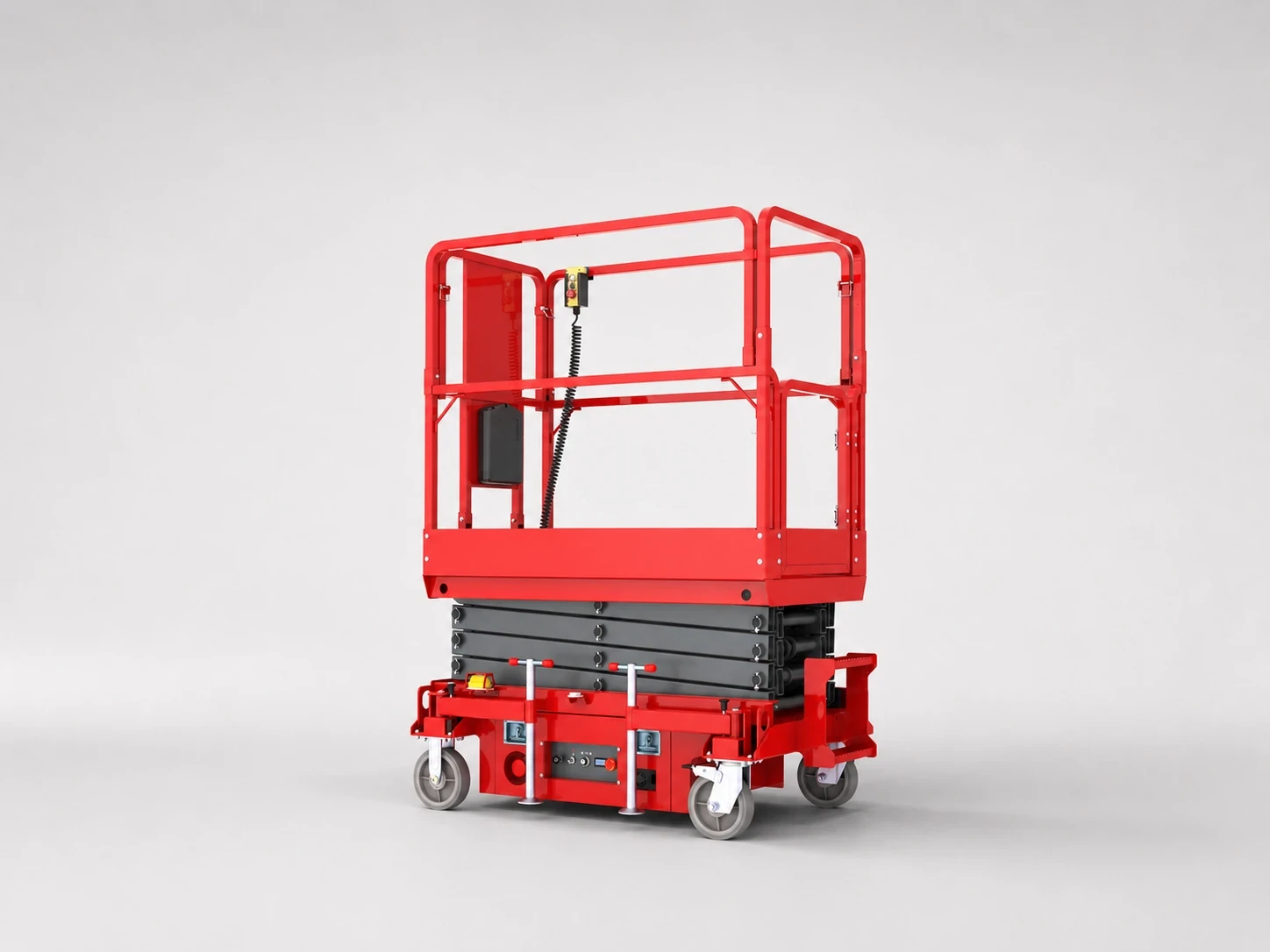
Compact scissor lifts are commonly considered for lighting replacement, ceiling inspections, retail maintenance, and other tasks performed inside buildings.
When choosing a compact model, prioritize:
A narrow chassis for passage through doorways and aisles.
A stowed height that accommodates overhead clearance.
A platform large enough for the operator and required equipment.
A rated working height suited to the task.
A permitted load capacity that covers the operator, tools, and materials.
For example, the WIZPLUS CKJC-EH series has a 760 mm overall width and a 1,280 × 700 mm platform. Its published working-height range is 5,000–6,800 mm, depending on the selected configuration.
This type of equipment may suit facilities that need a compact machine for regular indoor access, provided the site's dimensions and operating conditions are compatible with the selected model.

Semi-Electric Scissor Lifts
Semi-electric scissor lifts can be considered for applications where electric-powered lifting is required and manual repositioning is acceptable.
The WIZPLUS CKJC-Y series offers published working heights of 5,000–6,800 mm, with overall widths ranging from 670 to 810 mm across its listed configurations.
When evaluating a semi-electric model, check its travel method, stabilizer requirements, setup area, and operating procedure. Some configurations use stabilizers or outriggers that require additional space beyond the machine's basic chassis dimensions.
The nominal chassis width alone is therefore not enough to determine whether a lift can operate in a particular aisle or work area.
Higher-Reach Electric Scissor Lifts
Higher-reach scissor lifts provide elevated access for applications that require greater platform height or additional platform space.
The WIZPLUS CKJC-7858EH has a listed maximum platform height of 5,800 mm and maximum working height of 7,800 mm. Its platform measures 1,670 × 740 mm, with an extension-table length of 900 mm.
For applications that require still greater elevation, the WIZPLUS CKJC-HD series covers published working heights from 8,000 to 15,800 mm across different models.
Higher-reach equipment may also have a longer chassis, greater overall width, higher machine weight, and different floor-loading requirements. Buyers should assess the complete specification rather than choosing by height alone.
How to Choose the Right Scissor Lift Size
A structured selection process helps purchasing teams narrow the options before requesting a quotation.
1. Define the Required Working Height
Start with the highest point that operators need to reach. Confirm whether the supplier's stated height refers to the platform or the working height.
Do not automatically choose the tallest model available. A lift that is substantially larger than the task requires may be harder to maneuver and more expensive to transport or operate.
2. Measure the Access Route
Measure all relevant access points, including:
Doorway width and height.
Narrowest aisle or corridor.
Elevator entrance and internal dimensions.
Turning areas and storage locations.
Overhead beams, pipes, door closers, and other obstructions.
Check the equipment's dimensions in its actual transport configuration. If guardrails must be folded or removed to gain access, obtain confirmation from the manufacturer and follow its procedures.
Read also: Will a Scissor Lift Fit Through a Door? Dimensions and Clearance Guide.
3. Compare Platform Size and Rated Load
A platform needs enough usable space for the operator and the materials required for the job.
Calculate the combined weight of everyone, tools, and materials that may be on the platform at one time. Compare this total with the manufacturer's rated capacity and any separate restriction for an extension platform.
Never treat a larger platform as permission to carry additional weight beyond the rated limit.
4. Check Ground Conditions
Floor type and load-bearing capacity can affect equipment suitability. Consider the condition of the floor, slopes, thresholds, floor openings, surface irregularities, and any other route restrictions.
For outdoor work, determine whether the selected lift is rated for the proposed conditions. A model designed for level indoor floors should not be assumed suitable for uneven terrain.
Confirm any ground-bearing-pressure information, allowable gradients, and operating limitations with the manufacturer.
5. Evaluate the Complete Operating Area
The space needed to use a lift may exceed the machine's static footprint.
Account for turning and positioning, nearby workers, other vehicles, overhead hazards, and the intended direction of travel. If a model uses stabilizers or outriggers, allow for their full deployed footprint.
For applicable workplace requirements, consult the manufacturer's instructions and relevant regulations. In the United States, OSHA provides guidance on scissor lift safety, including worksite assessment, guardrails, stabilization, and safe positioning.
6. Confirm the Exact Model Before Purchase
Once you have identified a suitable size range, verify the complete technical datasheet. Check the following specifications together:
Maximum platform height and working height.
Overall width, length, and height.
Transport or folded-guardrail dimensions, where applicable.
Platform length and width.
Safe working load and extension-platform load.
Machine weight and relevant ground-loading information.
Drive method, power system, and intended operating environment.
For distributors and OEM buyers, also confirm available configurations, compliance documentation for the destination market, spare-parts arrangements, and packaging or shipping dimensions.
Scissor Lift Size Selection Checklist
Use this checklist before requesting a quotation or placing an order.
Required working height has been established.
Platform height and working height have been clearly distinguished.
Doorways, corridors, aisles, and elevators have been measured.
Platform dimensions suit the work task.
Combined operator, tool, and material weight is within the rated capacity.
Floor conditions and load-bearing requirements have been reviewed.
Guardrail configuration and transport height have been confirmed.
The selected model is appropriate for indoor or outdoor use.
The current technical datasheet has been checked for the exact configuration.
Completing these checks before purchase can reduce the risk of selecting equipment that reaches the correct height but cannot access or operate effectively in the intended workspace.
Common Mistakes When Comparing Scissor Lift Dimensions
Choosing by Working Height Alone
A lift may meet the height requirement but be too wide or long for the site. Always compare access dimensions and platform size alongside working height.
Confusing Platform Height With Working Height
These measurements describe different things. A stated working height should not be interpreted as the elevation of the platform itself.
Using Overall Dimensions Without Checking the Configuration
Folding guardrails, removable components, and extension platforms can affect the measurements relevant to transport or operation. Verify the exact configuration instead of relying on a generic product-family range.
Ignoring Stabilizer or Outrigger Space
Where a model requires stabilizers, the machine may need substantially more space during setup than its chassis dimensions suggest.
Overlooking Load Capacity
The operator is not the only load. Tools, replacement parts, installation materials, and equipment also count toward the applicable platform load limit.
Assuming Every Compact Lift Fits Every Doorway
A small chassis does not guarantee access through every opening. Door height, protruding components, thresholds, turning space, and the required transport configuration can all affect compatibility.
Frequently Asked Questions About Scissor Lift Sizes
What is the standard size of a scissor lift?
There is no universal standard size. Compact models may be around 670–810 mm wide, while larger configurations can be substantially wider and longer. Actual dimensions depend on the manufacturer, model, working height, load capacity, and platform design.
How wide is a small scissor lift?
Some compact scissor lifts are less than 800 mm wide. For example, the WIZPLUS CKJC-EH series lists an overall width of 760 mm. Buyers should verify the exact model specification and required access clearance before ordering.
How tall is a scissor lift when lowered?
The lowered height depends on the model and how its guardrails are configured. The WIZPLUS CKJC-EH series lists an overall height of 1,880–2,040 mm, with a reduced height of 1,520–1,680 mm when its guardrails are folded. Always confirm whether the measurement refers to the standard, folded, or guardrail-removed configuration.
What is the difference between platform height and working height?
Platform height is the distance from the ground to the elevated platform. Working height is the manufacturer's stated estimate of the height at which an operator can perform a task. It commonly includes an assumed operator reach above the platform, so the two measurements are not interchangeable.
How do I know if a scissor lift will fit through a doorway?
Compare the doorway's measured clear width and height with the lift's dimensions in the intended transport configuration. Also check protrusions, thresholds, turning space, and any restrictions on folding or removing components. Ask the supplier to confirm compatibility when clearance is limited.
Does a higher scissor lift always have a larger footprint?
Not necessarily, but higher-reach models may have larger chassis or platform dimensions. The relationship depends on the model design and rated capacity. Compare the full specifications instead of assuming that height alone predicts overall size.
What platform size is best for warehouse maintenance?
The best platform size depends on the task, the operator's work position, required tools, and the space available in the warehouse. Narrow chassis dimensions may be important in aisles, while additional platform area can help with maintenance tasks that require more equipment. The rated load must remain within the manufacturer's limits.
What should I check before buying a scissor lift for indoor use?
Check working height, platform height, overall width and length, lowered height, platform size, load capacity, floor conditions, and access through doorways and elevators. Confirm that the selected model is appropriate for the intended indoor environment and that all relevant operating restrictions can be met.
Conclusion: Choose a Scissor Lift That Fits the Entire Job
The right scissor lift size is determined by more than its maximum working height. Machine width, length, lowered height, platform dimensions, load capacity, and site clearance all affect whether a lift is suitable for a particular application.
Start by defining the required working height, then measure the access route and compare the complete specifications of suitable models. Before ordering, verify the exact configuration and current manufacturer datasheet.
WIZPLUSLIFT offers compact electric scissor lifts, semi-electric models, and higher-reach electric platforms for different industrial applications. Visit the WIZPLUSLIFT product range to compare available equipment, or contact the team with your required working height, platform load, access dimensions, and application details for model recommendations.