Scissor Lift Maintenance Schedule: Daily, Monthly and Annual Checklist
Published
Category
Guide
A practical scissor lift maintenance schedule: daily, weekly, monthly and annual checks, plus hydraulic, battery and record-keeping routines that hold up.
Who is actually responsible for keeping a scissor lift in working order?
Three different people, on three different clocks. The operator checks the machine before every shift, a competent technician services it monthly, and a qualified person inspects it at least annually. The written record is what turns that routine into something you can prove after an incident, an audit or a resale.
Most scissor lift failures are not dramatic. They are a weeping hose that becomes a burst hose, a pin that wears 2 mm and starts loading the weld beside it, or a battery that has been given tap water and a charger that never equalises. Each is cheap to catch early and expensive to miss.
The schedule below is built around how the machine is actually used: a ten-minute walkaround that fits before the first lift, a weekly clean and check, a monthly service by someone with tools, and an annual inspection by someone with instruments and a signature.
It is written for the machines that dominate construction, fit-out, warehousing and facility maintenance — small and mid-size electric and semi-electric scissor lifts with hydraulic lift circuits and battery power. The intervals are planning defaults; your manufacturer's manual always wins where it is more specific.
This guide gives you the checklists, the pass and fail criteria, the hydraulic and battery routines, the structural points that actually crack, and the record-keeping that satisfies an inspector without generating paperwork nobody reads.

Why a Written Maintenance Schedule Pays for Itself
A schedule is not bureaucracy. It is the cheapest diagnostic tool on site, because it converts a machine that "seems fine" into a list of things someone has actually looked at.
What Fails First
In small electric scissor lifts, the failures cluster. Batteries lose capacity long before they fail outright. Hydraulic hoses weep at fittings and chafe where they pass through the frame. Scissor arm pins and bushings wear, and the play they introduce loads welds that were never designed to take it. Wheel nuts loosen. Emergency lowering valves seize from disuse.
Almost none of those fail suddenly. They fail after months of being visible to anyone who looks, which is why the daily ten minutes matters more than the annual inspection.
Three Levels, Three Different People
An operator can check fluid levels, tyres, guards, labels and function. A competent technician can change fluid, adjust brakes, test the charger and torque fasteners. A qualified person — trained and authorised to inspect lifting equipment — can assess structure, welds and safety devices and certify the machine.
Confusing the three is how sites end up with a monthly "service" that is really a wipe-down, and an annual inspection that misses a cracked weld because nobody removed the deck plates.
Build It Around the Shift, Not the Calendar
A machine that runs two shifts a day accumulates wear twice as fast as one that runs one, so hour-based intervals beat calendar intervals wherever you can record hours. Where you cannot, shorten the calendar interval for high-utilisation machines rather than pretending the schedule fits both.
What the checks protect against differs by machine class: boom lifts and scissor lifts fail in different ways and carry different rescue considerations.
Daily and Weekly Checks
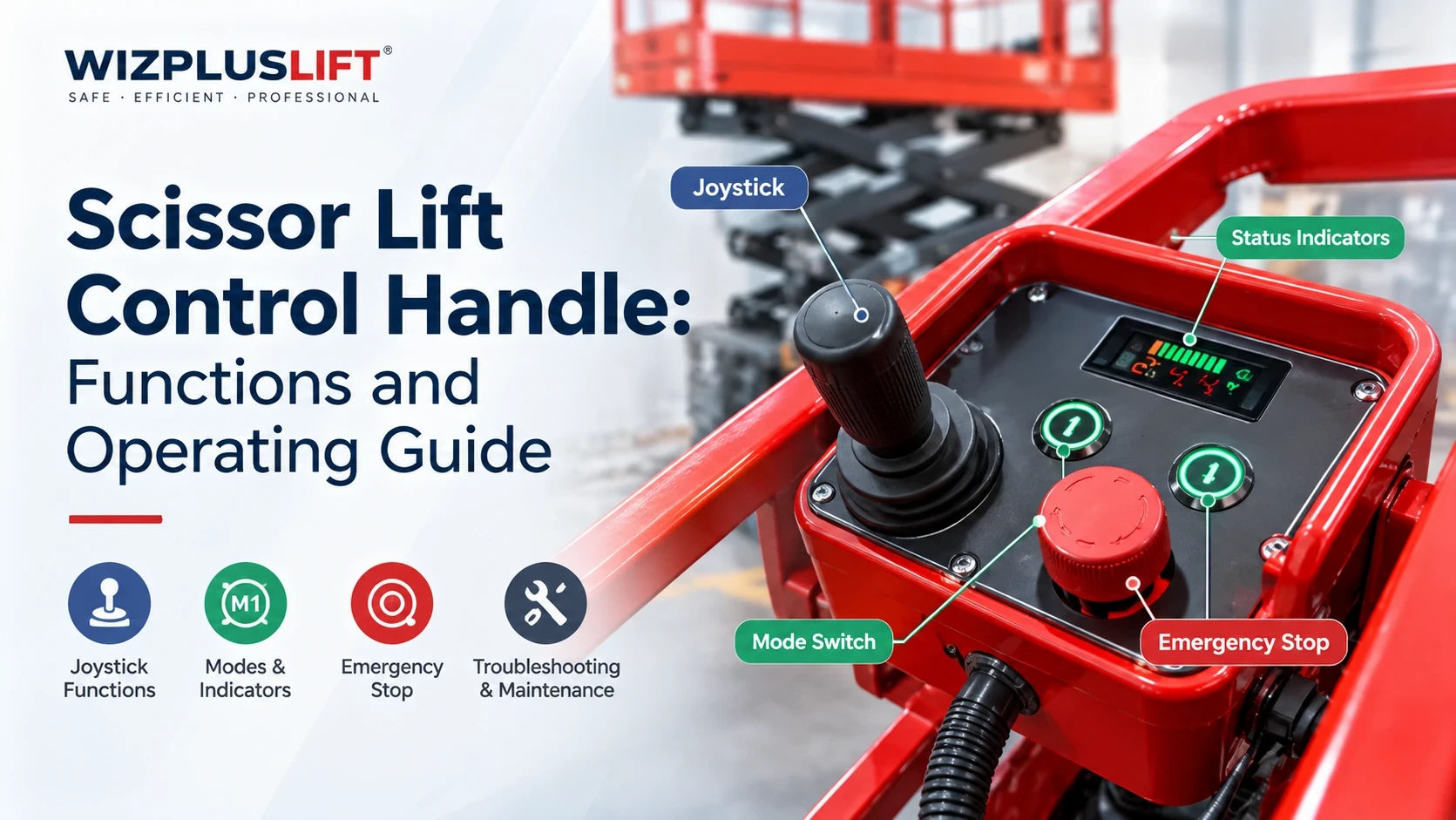
Most daily findings trace back to controls and interlocks, which is why the control handle and its operating modes deserve a deliberate check rather than a glance.
The pre-shift check is the only inspection that happens often enough to catch a problem before it becomes a breakdown. It should take about ten minutes and it should be signed.
The 10-Minute Pre-Shift Walkaround
Check | What good looks like |
|---|---|
Battery charge | Enough for the shift; charger disconnected and leads stowed |
Tyres and wheels | No flat spots, cuts or embedded debris; nuts present and tight |
Hydraulic leaks | No oil film on rams, hoses, fittings or the floor beneath |
Fluid level | Between the marks with the platform fully lowered on level ground |
Hoses and cables | No chafing, bulging, cracking or weeping at crimps |
Guardrails and gate | All rails secure, gate latches and self-closes, toe boards fitted |
Deck and extension | Clean, no cracks, extension latches engaged |
Labels and manual | Capacity and warning labels legible; manual on the machine |
Emergency stop | Trips when pressed, resets cleanly, no tape or wedges |
Function test | Raises and lowers smoothly through full travel, holds without drift, no unusual noise |
What Pass and Fail Look Like
A pass is a positive observation, not the absence of an obvious problem. "No leaks" means you looked at the rams, the hose ends and the floor under the machine. "Brakes hold" means you tested them on the slope or ramp you actually use.
A fail is anything that affects the machine's ability to lift, hold or stop safely: a leaking hose, an inoperative emergency stop, a cracked weld, a missing guardrail pin, a battery that will not take charge. The machine is tagged out and removed from service. It does not get "used carefully until Friday".
Weekly Additions
Clean the battery top and terminals; check electrolyte level on flooded lead-acid after charging.
Test the horn, work lights and any tilt or overload indicator.
Check scissor arm pins and bushings for visible play by rocking the raised platform gently.
Re-torque wheel nuts to the manufacturer's figure after the first week of a new machine, then on schedule.
Wash the machine down and inspect for cracks while it is clean — dirt hides them.
Those checks sit inside a regulatory framework, and OSHA's scissor lift safety requirements set the floor for what a written schedule has to cover.
Monthly Checks
The monthly service is where an operator's eye ends and a technician's tools begin. Allow two to four hours for a thorough job on a compact machine.
Hydraulic System Checks
Check fluid condition, not just level: dark, milky or gritty fluid means contamination and possibly a failing seal. Inspect every hose along its full length, especially where it bends, chafes against the frame or passes near a weld. Look for seeping at crimps, which is the earliest sign of a hose that will fail under pressure.
Test the relief valve setting and check for drift: a platform that sinks slowly under load has an internal leak in the cylinder or valve block, and that is a repair, not a top-up.
Structure, Fasteners and Welds
Inspect the welds at the scissor arm pivots, the platform corners, the base frame and the cylinder mounts. Cracks start at weld toes and at the ends of stiffeners, and they are easiest to see with the machine clean and the deck plates lifted.
Check fasteners for torque and for missing items, and check the pins and bushings for play. Worn bushings are cheap; the cracks they cause are not.
Battery and Charger
Monthly task | Why it matters |
|---|---|
Measure electrolyte specific gravity, cell by cell | A weak cell drags the whole pack down and predicts failure |
Check charger output voltage and cut-off | A charger that under-charges causes sulfation; one that overcharges boils the pack |
Inspect terminals for corrosion and tightness | Resistance here produces heat, voltage drop and false "flat battery" reports |
Test emergency lowering | A valve that has not moved in a year may not move in an emergency |
Test tilt and overload protection | These are the two devices that stop a tip-over before the operator does |
Brake and drive function test | Parking brake must hold on the maximum slope the site allows |
A service report is only readable if you know the parts it names, so learn the scissor lift mechanism and its components before the annual inspection, not after.
Annual and Periodic Inspection
The annual inspection is a structural and functional assessment by a qualified person, not a longer version of the monthly service. It typically takes half a day and it should produce a document with a date, a result and a next-due date.
What an Annual Inspection Covers
The inspector works through the manufacturer's inspection procedure: the base frame and outriggers, the scissor stack and its pins, bushings and wear pads, the platform and gate, the hydraulic cylinders and hoses, the electrical system, the battery and charger, and every safety device — tilt, overload, pothole protection, emergency lowering and the emergency stop.
Load testing at rated capacity is standard for lifting equipment and is usually combined with a functional test of each safety device under load, not just at rest.
Choosing an Inspector
Look for training against the relevant standard for mobile elevating work platforms, experience with scissor-type machines specifically, and insurance. Ask what the report contains: a checklist of items inspected, measured values where relevant, defects found, a pass or fail statement and the next inspection due date.
A one-page certificate with no measurements is not an inspection report. It is a receipt.
The Whole Schedule on One Page
Interval | Who | Core tasks | Typical time |
|---|---|---|---|
Pre-shift | Operator | Walkaround, fluid, guards, function test | 10 minutes |
Weekly | Operator or supervisor | Clean, battery terminals, lights, pins, wheel nuts | 30–45 minutes |
Monthly | Competent technician | Fluid condition, hoses, structure, battery test, brakes | 2–4 hours |
Annual | Qualified person | Structural inspection, load test, safety devices, certification | Half a day |
Service intervals follow the drive system, and telling electric, semi-electric and hydraulic machines apart is the first thing to establish when you inherit a fleet.
Hydraulic, Battery and Structural Care
Beyond the checklists, four systems decide whether a scissor lift reaches ten years or five: the hydraulic circuit, the battery, the scissor stack and the running gear.
Hydraulic Fluid and Hoses
Use the fluid grade specified in the manual, and do not mix grades to top up. Contamination is the main cause of valve wear, so change fluid on the manufacturer's interval and keep the reservoir cap and breather clean. Store spare hoses capped, and replace rather than repair a hose that has bulged or been abraded through its outer layer.
Battery Care by Chemistry
Flooded lead-acid needs water after charging — never before — to the correct level, with distilled or deionised water, and a periodic equalising charge. Keep the top dry and the terminals clean and tight, and never let it stand discharged. Lithium packs need far less: a visual check, a clean terminal, and a management system that is allowed to do its job — which means charging within the specified temperature range and not storing the pack flat for months.
Pins, Rollers and Scissor Arm Wear
The scissor stack is a linkage, and linkages wear at the joints. Check bushings for ovality and pins for grooving, and replace wear pads before metal-to-metal contact starts. Grease the specified points on the specified interval; on machines used outdoors or in dusty sites, shorten that interval, because abrasive paste wears a joint faster than dry metal does.
Wheels, Brakes and Pothole Protection
Check tyre condition and pressure where applicable, wheel nut torque and bearing play. Test the parking brake on the steepest slope the site permits, and test pothole protection bars for free movement and correct deployment — a bar that is bent or seized will not stop a tip-over.
Hydraulic and electric machines fail in different places — hoses and seals versus battery and drive electronics — so the hydraulic versus electric split determines which spares you keep on the shelf.
Records, Compliance and Handover
A maintenance programme that exists only in people's heads is worth nothing in an audit and very little in a resale negotiation.
What to Record
For every inspection, record the machine serial number and hour meter reading, the date, the checks performed, any defects found, the action taken, who did it and when the next inspection is due. Photograph defects — a crack photographed before repair is evidence; a crack described in a notebook is an opinion.
Keep records for the life of the machine plus the period your jurisdiction requires, and keep them with the machine when it moves between sites.
OSHA 1910.178 and ANSI A92.22 in Plain Terms
In the United States, OSHA's powered industrial truck standard, 1910.178, is the rule most general-industry sites apply to mobile lifting equipment: it expects a pre-shift examination, removal from service when a machine is found defective, and a record of the examination for machines not in routine use. ANSI A92.22, the safe-use standard for mobile elevating work platforms, puts the inspection and training obligations on the user and points back to the manufacturer's manual for intervals and procedures.
Neither standard replaces the manual. Where your manual specifies a 250-hour service or a specific fluid, that is the requirement; the standards define who is responsible and what a defensible programme looks like.
Handover: New Site, New Operator, New Owner
Every time the machine changes hands, the file should go with it: the manual, the inspection records, the last annual certificate and any open defects. A new operator needs familiarisation on that specific machine, not a generic induction, and a new site needs the machine's limits — floor loading, slope, wind exposure if used outdoors — stated before the first lift.
WIZPLUSLIFT supplies electric and semi-electric scissor lifts across the construction and maintenance solutions range, and ships each machine with the documentation needed to start a maintenance file.
The pre-shift items that matter most are the ones OSHA's inspection checklist names, and the faults that follow a skipped service are usually the same five electric scissor lift problems reappearing.
If you are specifying rather than maintaining, the handover pack is part of what you are buying: choosing a compact scissor lift should include the service schedule and documentation.
Frequently Asked Questions
How often should a scissor lift be inspected?
A pre-shift check by the operator, a weekly clean and visual inspection, a monthly service by a competent technician, and a full inspection by a qualified person at least annually or at the interval in the manufacturer's manual, whichever comes first. High-utilisation or harsh-site machines often need shorter intervals.
What is included in a daily scissor lift inspection?
Battery charge, tyre and wheel condition, hydraulic leaks and fluid level, hose and cable condition, guardrails and gate latches, deck and extension, labels and manual, emergency stop, and a full raise-lower function test with the brakes checked on a slope.
Who is allowed to inspect a scissor lift?
Operators may perform the pre-shift checks they have been trained for. Monthly servicing needs a competent technician. The annual structural inspection should be done by a qualified person with training in mobile elevating work platforms and the authority to certify the machine.
How long does a scissor lift last with proper maintenance?
A well-maintained electric scissor lift commonly reaches eight to twelve years in indoor service, with battery replacement every three to six years and hose or seal work along the way. Outdoor and dusty sites shorten that considerably unless the service intervals are shortened to match.
What maintenance does a scissor lift battery need?
Flooded lead-acid needs watering after charging with distilled water, clean tight terminals, and periodic equalising. Lithium packs need a clean terminal, a visual check, charging within the specified temperature range, and no long-term storage at very low charge.
Can I use a scissor lift if a defect is found during inspection?
Only if the defect does not affect safe operation and has been assessed as such. Anything affecting lifting, holding, stopping, guarding or stability means the machine is tagged out and removed from service until repaired and re-inspected.
Do I need to keep written maintenance records?
Yes, in practice. Records demonstrate that inspections happened, support a warranty or insurance claim, and are expected by auditors and buyers. Keep serial number, hours, date, checks, defects, actions and the inspector's name.
What is the most commonly missed maintenance item?
Emergency lowering and the pothole protection system, because neither is exercised in normal work. Both should be tested monthly, and a device that has not moved in a year may not move when it is needed.
Conclusion: The Checklist Is the Cheap Part
A scissor lift does not fail because someone forgot to buy a part. It fails because nobody looked at the hose, the pin or the weld on the day it started to go wrong. The schedule above exists to make looking routine, recorded and repeatable.
Start with the ten-minute pre-shift check, add the monthly service, book the annual inspection, and keep the file with the machine. Everything else in this guide is detail on top of those three habits.
WIZPLUSLIFT builds scissor lifts for construction, warehouse and facility teams and can supply the maintenance schedule and documentation pack for the model you buy. Send your machine details through the contact page and the team will confirm the service intervals for your model.