Blog
Types of Scissor Lifts: Electric, Semi-Electric, Hydraulic & Rough Terrain
Published
Category
Scissor Lift
Explore the main types of scissor lifts, including electric, semi-electric, hydraulic and rough terrain models, and learn how to choose the right type.
What Are the Different Types of Scissor Lifts?
Scissor lifts are available in different configurations to meet the requirements of warehouses, factories, construction sites, maintenance teams and other elevated work applications.
Although most scissor lifts use a vertical lifting mechanism, they can differ significantly in their power source, travel system, platform configuration, working height, load capacity and operating environment.
The main types include:
Electric scissor lifts
Semi-electric scissor lifts
Full electric scissor lifts
Hydraulic scissor lifts
Rough terrain scissor lifts
Choosing the right type depends on where the machine will operate and what the operator needs to accomplish.
For example, an indoor warehouse may prioritize compact dimensions, battery operation and low operating noise, while an outdoor construction project may require greater ground clearance and terrain capability.
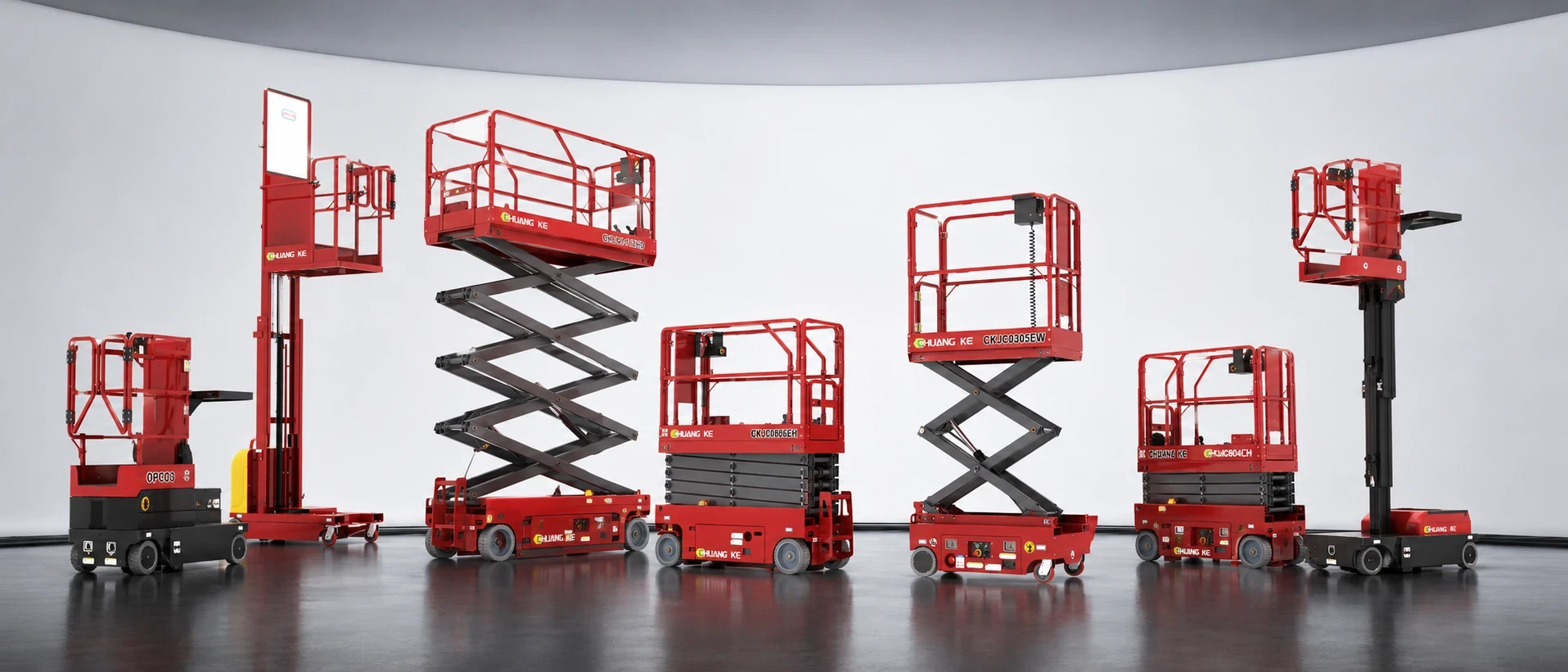
Electric Scissor Lift
An electric scissor lift uses an electric motor and battery system to power the lifting function and, depending on the design, other machine functions such as travel.
Electric models are commonly considered for indoor and controlled environments because they do not require a combustion engine during normal operation.
Where Are Electric Scissor Lifts Used?
Common applications include:
Warehouses
Manufacturing facilities
Commercial buildings
Retail facilities
Facility maintenance
Indoor installation work
Electric scissor lifts can be particularly useful where operators need elevated access without the emissions associated with combustion-powered equipment.
What Should You Consider?
When choosing an electric scissor lift, consider:
Battery capacity
Charging time
Working height
Platform height
Load capacity
Overall dimensions
Floor conditions
Operating hours
Battery capacity should be evaluated together with the expected work cycle. A machine that operates for several hours every day may require a different battery configuration from one used for occasional maintenance.
Semi-Electric Scissor Lift
A semi-electric scissor lift combines electrically powered lifting with a simpler travel arrangement.
Depending on the specific design, the machine may need to be manually repositioned between work areas while the lifting function is powered.
This configuration can be practical when the primary requirement is to raise an operator to an elevated working position rather than travel continuously across a large facility.
When Is a Semi-Electric Scissor Lift a Good Choice?
A semi-electric model may be suitable for:
Small warehouses
Indoor maintenance
Inventory access
Equipment inspection
Facility work
Occasional elevated tasks
The main advantage is that buyers can obtain powered lifting without necessarily paying for a more complex powered travel system.
However, if operators need to move the machine frequently over long distances, a full electric or self-propelled configuration may be more appropriate.
WIZPLUS CKJC-Y Semi-Electric Scissor Lift Platform
WIZPLUS offers the CKJC-Y series as a semi-electric scissor lift platform for applications requiring powered vertical lifting and a compact working configuration.
The series includes different models with varying platform heights, working heights and load capacities. This allows buyers to select a configuration based on the actual application instead of choosing a single machine specification for every project.
For buyers considering this type of equipment, the required working height, platform capacity, machine width and frequency of repositioning should be confirmed before selecting a model.
Full Electric Scissor Lift
A full electric scissor lift uses electric power for both lifting and machine travel.
This configuration is designed for applications where operators need to move between different working locations without manually repositioning the equipment.
Advantages of Full Electric Scissor Lifts
The main advantages can include:
Powered travel
Reduced manual repositioning
Improved mobility
Suitable for repeated movement
Convenient operation in larger facilities
Full electric models can be particularly useful in warehouses and facilities where elevated work is combined with frequent movement between different locations.
When Should You Choose Full Electric?
A full electric scissor lift may be appropriate when:
Operators move frequently between work areas
The facility is relatively large
The machine operates for extended periods
Productivity is a major consideration
However, a full electric model may be unnecessary for applications where the machine only needs to be repositioned occasionally.
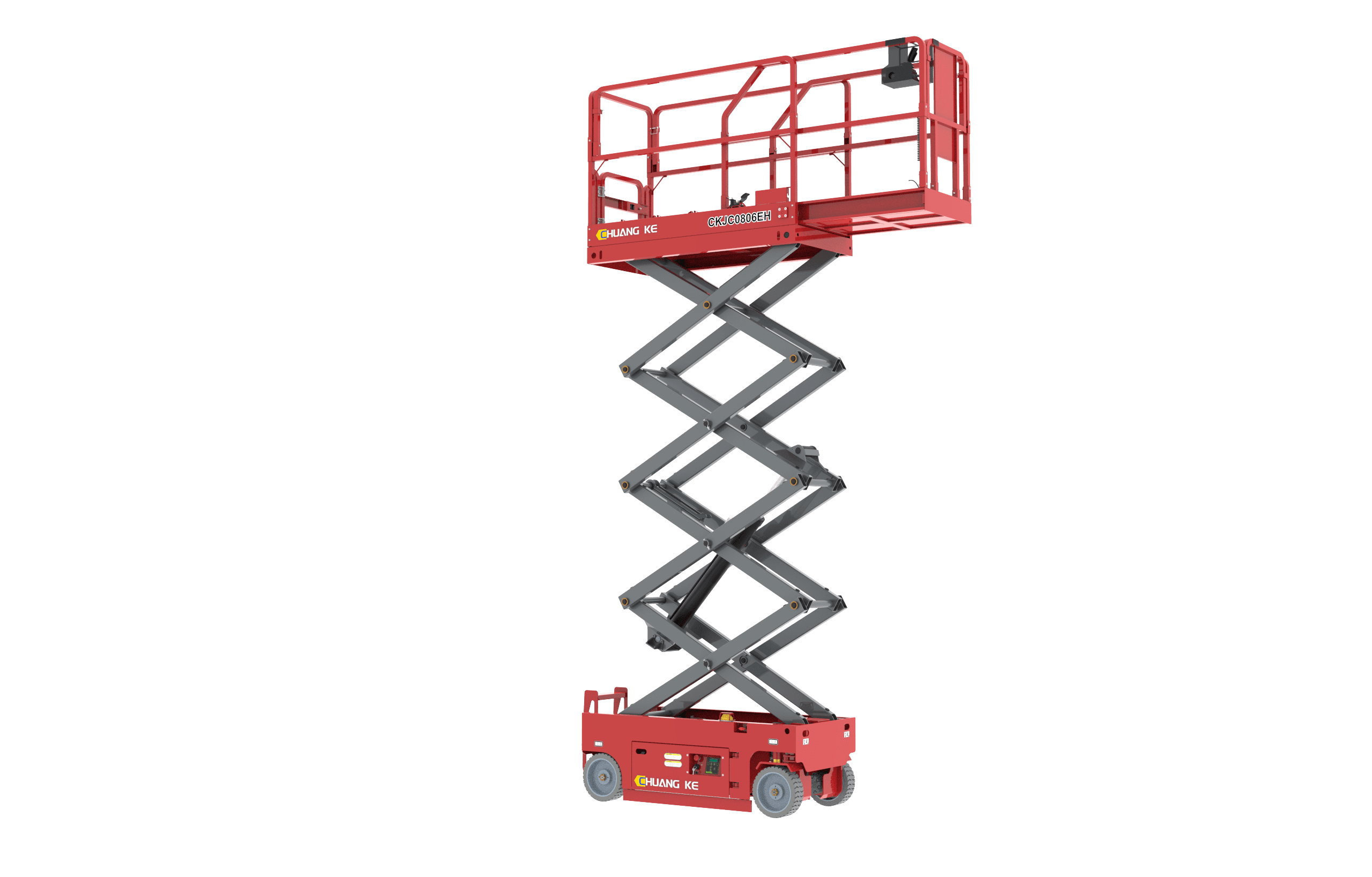
Hydraulic Scissor Lift
Hydraulic scissor lifts use a hydraulic system to generate the lifting force required to raise the platform.
Hydraulic technology is widely used in lifting equipment because hydraulic systems can provide substantial lifting force and controlled movement.
Where Are Hydraulic Scissor Lifts Used?
Depending on their design, hydraulic scissor lifts may be used in:
Industrial applications
Construction
Material handling
Maintenance
Heavy-duty lifting
The appropriate hydraulic configuration depends on the required capacity, working height, environment and operating frequency.
Hydraulic vs Electric Scissor Lift
The choice between hydraulic and electric systems should be based on the application rather than assuming that one technology is universally better.
Electric models may be attractive for indoor applications where battery operation and lower operating noise are important.
Hydraulic systems may be appropriate when the application requires a particular lifting configuration or capacity.
Buyers should compare the complete machine rather than looking at the lifting technology alone.
Rough Terrain Scissor Lift
Rough terrain scissor lifts are designed for outdoor applications where ground conditions can be more challenging than those found inside warehouses or factories.
Compared with compact indoor machines, rough terrain models are generally designed around greater stability and mobility on uneven surfaces.
Typical Features
Depending on the model, rough terrain scissor lifts may include:
Larger tires
Greater ground clearance
Higher capacity
Stabilizing systems
Outdoor-oriented drive systems
Where Are Rough Terrain Scissor Lifts Used?
Common applications include:
Construction sites
Outdoor installation
Building maintenance
Industrial sites
Infrastructure projects
A rough terrain machine should not be selected simply because it offers higher specifications.
If the machine will operate entirely on a smooth warehouse floor, a compact electric model may be more practical.
Indoor Scissor Lift vs Outdoor Scissor Lift
The working environment is one of the most important factors when selecting a scissor lift.
Indoor Scissor Lifts
Indoor applications often prioritize:
Compact dimensions
Low operating noise
Battery operation
Maneuverability
Suitable floor loading
Narrow access
Electric and semi-electric models can be suitable for many indoor applications, depending on the specific machine design.
Outdoor Scissor Lifts
Outdoor applications may require:
Greater ground clearance
Larger wheels
Higher stability
Weather-resistant components
Capability for different surface conditions
The machine should be selected according to the actual site conditions rather than simply classified as an indoor or outdoor machine.
Self-Propelled vs Manually Repositioned Scissor Lifts
Another important distinction is how the machine travels.
A self-propelled scissor lift uses powered travel, allowing the operator to move the machine using its controls.
A manually repositioned model requires the operator or another worker to move the machine between locations.
Self-Propelled Scissor Lift
Self-propelled models are more suitable when:
Travel is frequent
Work areas are spread out
Productivity is important
The machine is used throughout the day
Manually Repositioned Scissor Lift
A manually repositioned machine may be suitable when:
Travel distances are short
The machine is used occasionally
Elevated access is the main requirement
A simpler configuration is preferred
The choice should be based on the actual number of movements during a typical shift.
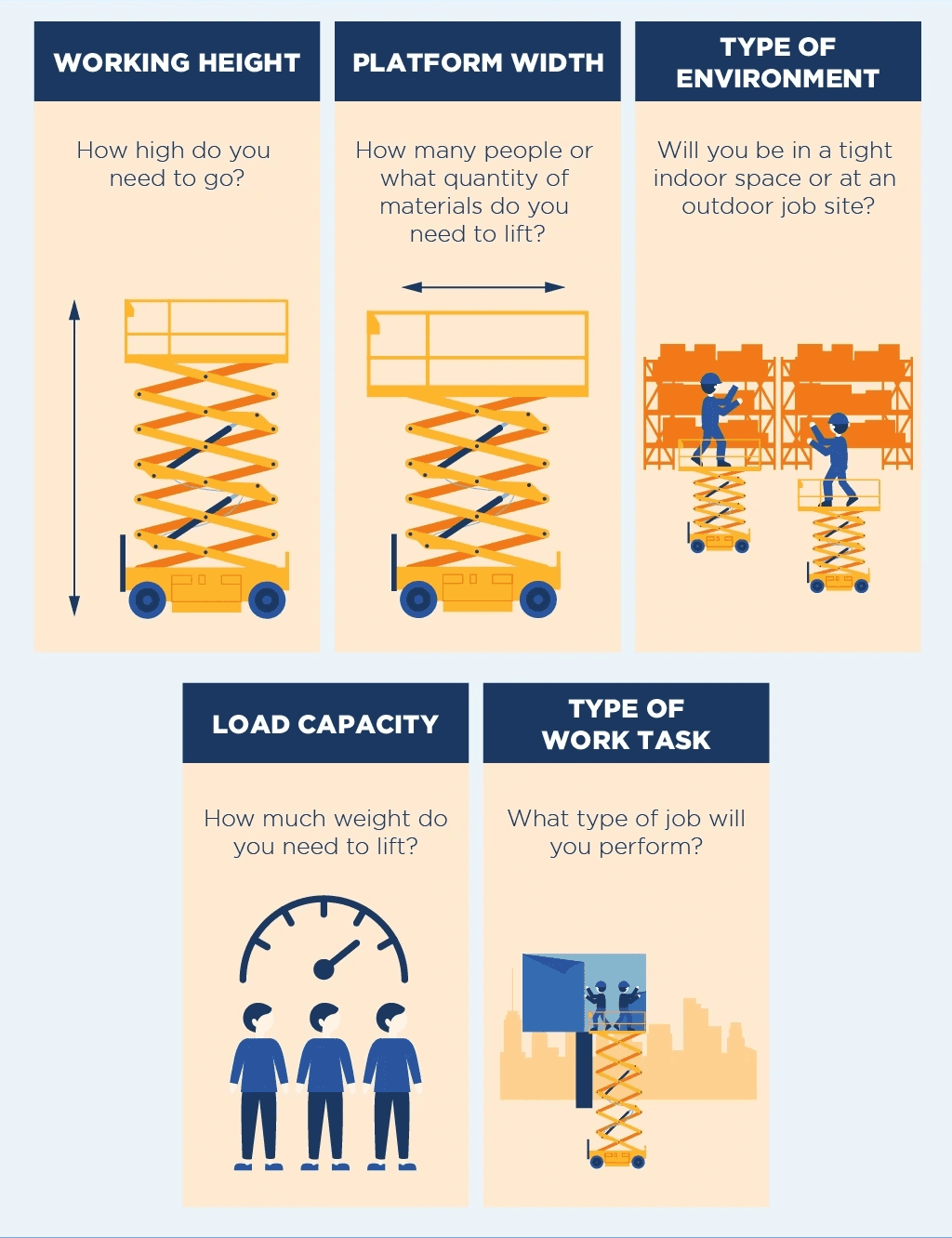
How Do You Choose the Right Type of Scissor Lift?
There is no single best type of scissor lift for every application.
A practical selection process starts with the working conditions.
1. Determine the Required Working Height
Identify the highest point where the operator needs to perform work.
Do not automatically choose the highest available model.
A machine with significantly more height than required may increase purchase cost, transportation requirements and overall dimensions.
2. Determine the Required Load Capacity
Consider the combined weight of:
Operator
Tools
Materials
Other permitted equipment
Always follow the manufacturer's rated capacity.
3. Check the Operating Environment
Determine whether the machine will be used:
Indoors
Outdoors
On smooth floors
On uneven surfaces
In narrow aisles
The environment can determine which machine types are appropriate.
4. Evaluate Travel Frequency
Ask how frequently the machine will be repositioned.
Frequent movement may justify a self-propelled or full electric configuration.
Limited movement may make a semi-electric or simpler configuration more practical.
5. Check Machine Dimensions
Measure:
Door openings
Aisle widths
Turning areas
Storage spaces
Transportation routes
Machine width can be just as important as lifting height in a warehouse.
6. Consider Battery Requirements
For electric models, evaluate:
Battery capacity
Operating hours
Charging time
Number of lifting cycles
Travel distance
The battery should match the expected work cycle.
Scissor Lift Type Comparison
Type | Power Configuration | Typical Application | Main Consideration |
|---|---|---|---|
Electric Scissor Lift | Battery-powered electric system | Indoor warehouses, factories and maintenance | Battery and charging requirements |
Semi-Electric Scissor Lift | Electric lifting with simpler movement | Small facilities and occasional elevated work | Travel frequency |
Full Electric Scissor Lift | Electric lifting and travel | Warehouses and frequent picking or maintenance | Battery and drive system |
Hydraulic Scissor Lift | Hydraulic lifting system | Industrial and heavy-duty applications | Capacity and system configuration |
Rough Terrain Scissor Lift | Designed for outdoor operation | Construction and uneven surfaces | Ground conditions and stability |
The categories can overlap depending on the manufacturer's design. For example, a scissor lift can be both electric and self-propelled.
Therefore, buyers should look at the complete equipment configuration rather than relying on one category name.
Common Mistakes When Choosing a Scissor Lift
Choosing the Highest Machine Available
More height is not always better.
The correct machine should provide enough working height for the application while maintaining suitable dimensions and operating characteristics.
Ignoring Travel Requirements
A machine may meet the required height and capacity but still be inefficient if operators need to manually reposition it dozens of times per day.
Choosing Based Only on Price
Initial purchase price does not represent the complete cost of ownership.
Consider:
Battery
Maintenance
Spare parts
Productivity
Transportation
Service support
Ignoring Warehouse Dimensions
Always check doorways, aisles and turning areas before purchasing.
Confusing Platform Height and Working Height
These are different specifications and should be compared carefully between manufacturers.
What Information Should You Give a Scissor Lift Manufacturer?
When requesting a quotation, provide as much application information as possible.
Useful information includes:
Required working height
Platform height requirement
Maximum load
Platform size
Aisle width
Floor conditions
Indoor or outdoor application
Daily operating hours
Travel frequency
Destination country
Quantity required
If possible, provide warehouse photographs, layout drawings or dimensions.
This allows the manufacturer to recommend equipment based on actual working conditions instead of making a recommendation based only on the requested lifting height.
Frequently Asked Questions
What are the main types of scissor lifts?
The main categories include electric, semi-electric, full electric, hydraulic and rough terrain scissor lifts. Some categories can overlap because a machine may combine an electric power system with self-propelled travel.
What is the best type of scissor lift for indoor use?
Electric and semi-electric scissor lifts can be suitable for many indoor applications. The final choice depends on working height, load capacity, machine dimensions, floor conditions and travel requirements.
What is a semi-electric scissor lift?
A semi-electric scissor lift generally uses electric power for lifting while using a simpler movement arrangement. It can be suitable when elevated access is required but frequent powered travel is not necessary.
What is the difference between full electric and semi-electric scissor lifts?
The main difference is usually the travel system. A full electric model uses electric power for both lifting and travel, while a semi-electric model generally provides powered lifting with simpler movement between locations.
Are hydraulic scissor lifts better than electric scissor lifts?
Neither is universally better. Electric models can be well suited to many indoor applications, while hydraulic systems may be selected for particular industrial or heavy-duty requirements. The correct choice depends on the complete application.
Are rough terrain scissor lifts suitable for warehouses?
They can be used in some warehouse-related environments, but their larger size and outdoor-oriented design may be unnecessary for smooth indoor floors. Compact electric equipment may be more practical for many indoor applications.
How do I choose the right scissor lift?
Start with the required working height and load capacity. Then evaluate machine dimensions, operating environment, travel frequency, power system, battery requirements and daily usage.
Can a scissor lift be customized?
Depending on the manufacturer and model, customization may be available for items such as battery configuration, power options, platform configuration and other equipment specifications. Buyers should confirm available options directly with the manufacturer.
Choosing the Right Scissor Lift for Your Application
The best scissor lift is not necessarily the largest, highest or most powerful machine.
For an indoor warehouse, a compact electric or semi-electric model may provide the right balance of access, dimensions and operating simplicity.
For a large facility with frequent movement, a full electric self-propelled model may be more appropriate.
For demanding outdoor environments, a rough terrain scissor lift may be necessary.
For industrial lifting requirements, a hydraulic configuration may provide the required performance.
The most reliable approach is to start with the actual job requirements and then match the equipment configuration to those requirements.
For buyers considering a semi-electric solution, the WIZPLUS CKJC-Y series can be evaluated based on its available working heights, platform configurations and application requirements.
Other Blogs