Blog
Scissor Lift Load Capacity: How Much Weight Can a Scissor Lift Hold?
Published
Category
Scissor Lift
Scissor Lift Load Capacity: Learn how to calculate rated load, operator and material weight, and choose the right scissor lift capacity for your application.
Choosing a scissor lift based on load capacity is more complicated than simply looking for the largest number on a specification sheet.
A machine rated for 300 kg, for example, is not designed to carry 300 kg of materials in addition to the operator. The rated working load generally needs to account for the people, tools, materials and other permitted items carried on the working platform.
For warehouse managers, facility maintenance teams, equipment distributors and industrial buyers, understanding scissor lift load capacity is essential before selecting or ordering equipment.
The correct capacity depends on the machine configuration, platform design, working height, operating conditions and the manufacturer's rated specifications.
This guide explains what scissor lift capacity means, what counts toward the rated load, how to compare models and what buyers should check before placing an order.
What Is Scissor Lift Load Capacity?
Scissor lift load capacity is the maximum rated load that the equipment is designed to support under specified operating conditions.
Depending on the manufacturer, you may see terms such as:
Rated capacity
Safe working load
Platform capacity
Maximum load
Working load
Rated platform load
These terms should not automatically be assumed to have identical definitions across every manufacturer.
For procurement, the manufacturer's technical documentation for the specific model should always be treated as the primary reference.
The important point is that load capacity applies to the total permitted load on the working platform, not simply to the materials being lifted.
What Counts Toward Scissor Lift Capacity?
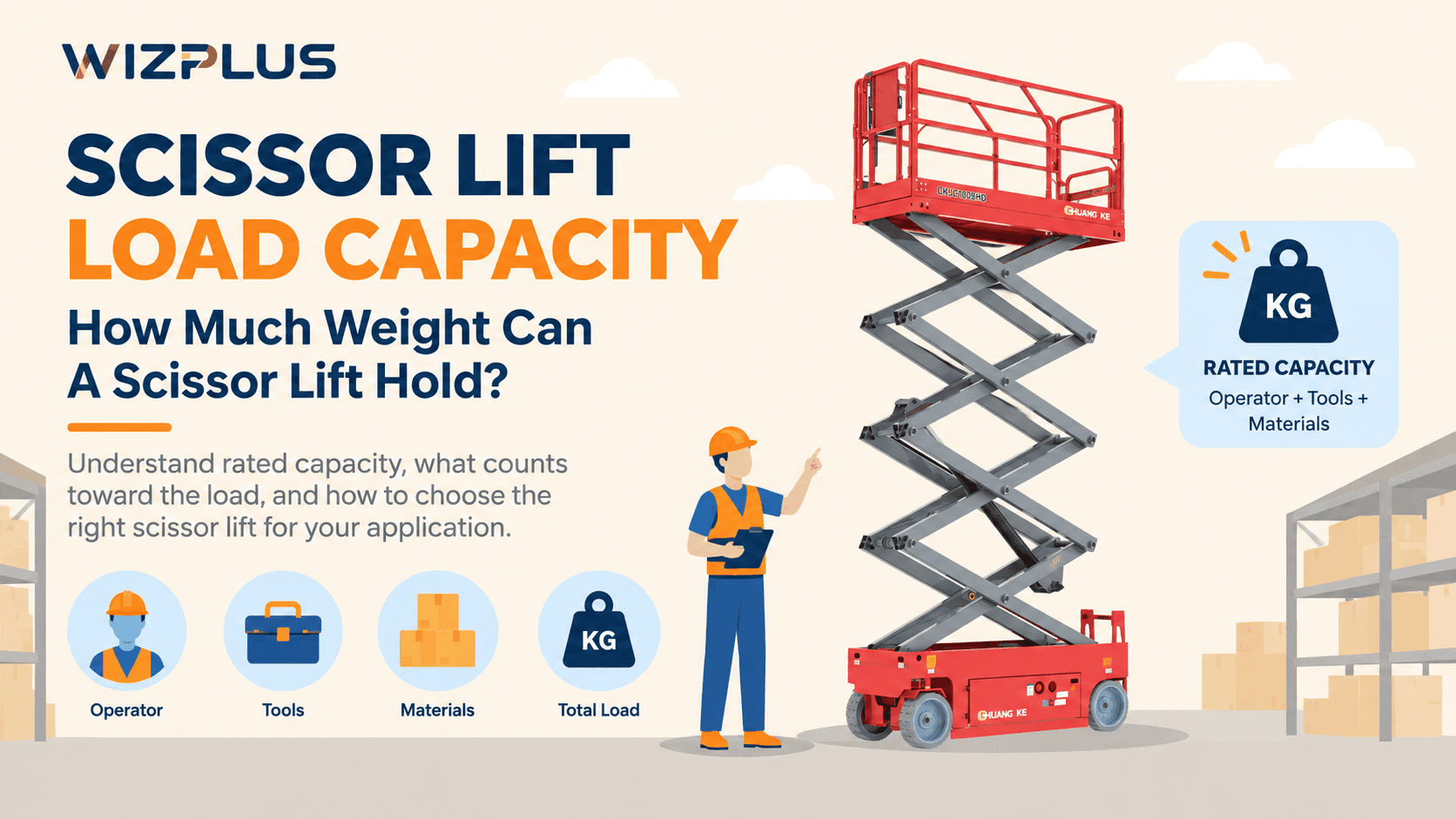
When evaluating a scissor lift rated for a particular capacity, buyers should consider everything that is permitted to be carried on the platform.
Operator Weight
If the equipment is designed for personnel access, the operator's weight forms part of the working load.
For example, if a platform has a rated capacity of 300 kg and an operator weighs 80 kg, the operator already accounts for 80 kg of the rated load.
Tools and Equipment
Tools carried by the operator also contribute to the platform load.
This may include:
Power tools
Hand tools
Measuring equipment
Maintenance equipment
Installation tools
A maintenance team should therefore calculate the expected working load before selecting the machine.
Materials
Materials placed on the platform also count toward the permitted load.
For example, an installation task might involve:
Replacement components
Lighting equipment
Electrical materials
Fasteners
Installation hardware
The combined load must remain within the manufacturer's rated limit.
Other Permitted Items
Any additional equipment or materials carried on the platform should be included when calculating the working load.
The machine's operating instructions should always be followed because some manufacturers may specify additional restrictions regarding occupants, material distribution or platform use.
How Much Weight Can a Scissor Lift Hold?
There is no single load capacity that applies to every scissor lift.
Capacity varies according to the specific model and design.
Compact scissor lift platforms may have relatively modest rated loads, while larger industrial or rough-terrain machines can be designed for substantially greater loads.
For this reason, buyers should avoid searching for a generic answer such as:
"How many kilograms can a scissor lift lift?"
The more useful question is:
"What is the rated capacity of the specific scissor lift model I am purchasing?"
For example, the WIZPLUS CKJC-Y semi-electric scissor lift platform series lists a 300 kg safe working load across the CKJC0503Y, CKJC0604Y and CKJC0705Y configurations.
That specification should be understood as the rated working load for the relevant machine configuration, rather than 300 kg of materials in addition to the operator.
A Practical 300 kg Capacity Example
Consider a scissor lift with a rated safe working load of 300 kg.
Suppose the intended task involves:
Load Item | Example Weight |
|---|---|
Operator | 80 kg |
Tools | 20 kg |
Materials | 100 kg |
Total Working Load | 200 kg |
The calculated working load is:
80 kg + 20 kg + 100 kg = 200 kg
The remaining rated capacity would therefore be:
300 kg − 200 kg = 100 kg
This calculation is useful for preliminary equipment selection.
However, the calculation does not override the manufacturer's operating instructions, occupant limitations, load distribution requirements or any applicable workplace requirements.
Does Operator Weight Count Toward Scissor Lift Capacity?
Yes, when the machine is designed for personnel access, the operator is part of the working load.
This is an important point that is sometimes overlooked during equipment purchasing.
A buyer may calculate:
"I need to lift 250 kg of materials."
But if the operator and tools add another 100 kg, the actual platform load could become 350 kg.
If the machine is rated for 300 kg, that configuration would not meet the stated load requirement.
The correct approach is to calculate the complete working load before selecting the machine.
Can a Scissor Lift Carry Two People?
This depends entirely on the specific machine's design and rated operating requirements.
A scissor lift should not be assumed to be suitable for two occupants simply because the platform appears physically large enough.
Before allowing multiple occupants, verify:
The manufacturer's permitted number of occupants
Rated platform capacity
Platform dimensions
Applicable operating requirements
The manufacturer's instructions
For example, a theoretical 300 kg platform capacity does not by itself mean that three 100 kg occupants are permitted.
Capacity and occupancy requirements are separate considerations.
Does Load Distribution Matter?
Yes.
The total weight is important, but where that weight is positioned can also matter.
A platform carrying a load evenly distributed across the permitted working area is different from one where a substantial load is concentrated in a small area.
Buyers should therefore consider:
Weight distribution
Material position
Platform configuration
Manufacturer load restrictions
The equipment should be operated according to the manufacturer's specified loading conditions rather than relying only on the total kilogram figure.
Scissor Lift Capacity vs Machine Weight
These two specifications are often confused.
Machine weight is the weight of the scissor lift itself.
Load capacity is the rated load the machine is designed to support.
For example, a scissor lift could weigh several hundred kilograms while having a platform capacity of 300 kg.
The machine's own weight does not mean that it has a 300 kg total physical weight limit.
This distinction is particularly important when reviewing product datasheets and comparing different manufacturers.
Scissor Lift Capacity vs Working Height
Load capacity should also be evaluated together with working height.
A scissor lift with a higher working height is not automatically more or less capable of carrying a specific load.
Capacity is determined by the particular machine design and rated configuration.
For this reason, buyers should never assume that:
Higher working height = lower capacity
or:
Higher working height = higher capacity
Instead, check the published specification for the exact model.
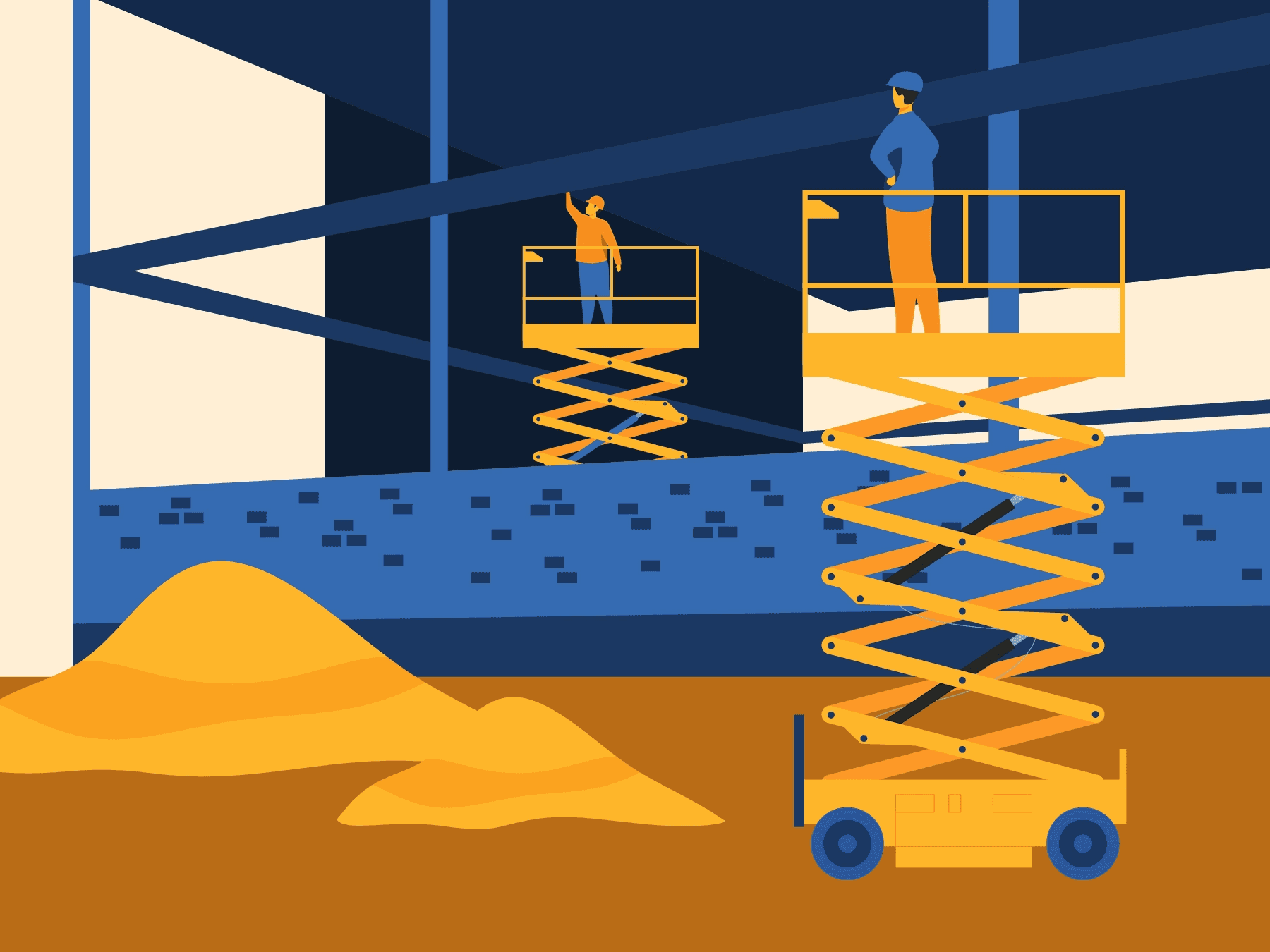
For the WIZPLUS CKJC-Y series, the three listed models provide different working heights while maintaining a 300 kg safe working load according to the product specifications.
How Working Height and Capacity Work Together
When selecting equipment, buyers should evaluate at least two separate requirements:
How high does the operator need to work?
and
How much total load needs to be carried?
For example:
Warehouse Lighting Maintenance
Required working height: approximately 6 m
Required load:
One operator
Tools
Replacement lighting components
The buyer needs a machine that meets both the required working height and the combined load.
Facility Inspection
Required working height: approximately 4 m
Required load:
One operator
Inspection equipment
Small tools
A lower-capacity machine may be sufficient if the total working load remains within its rated capacity.
This is why purchasing decisions should begin with the task rather than simply selecting the largest available model.
How to Choose the Right Scissor Lift Capacity
Step 1: Determine the Maximum Number of Occupants
Establish how many people need to work from the platform.
Do not assume that the platform can accommodate multiple occupants unless the specific model is designed and rated for that use.
Step 2: Calculate Operator Weight
Use the maximum expected operator weight rather than an average estimate when planning the equipment requirement.
Step 3: Add Tools and Equipment
Make a realistic list of everything that may be carried onto the platform.
Step 4: Add Materials
Include the maximum expected material load for the task.
Step 5: Check Load Distribution
Consider whether materials can be safely positioned within the permitted platform area.
Step 6: Compare With Rated Capacity
The total calculated working load must remain within the manufacturer's permitted rating.
Step 7: Check Other Machine Specifications
Capacity alone is not enough.
Also check:
Working height
Platform height
Platform dimensions
Overall width
Machine weight
Battery configuration
Floor conditions
Operating environment
Why Platform Size Matters
Platform size affects how operators position themselves, tools and materials.
A larger platform can provide more usable working space, but it does not automatically mean that the machine has a higher load capacity.
Similarly, a small platform can have a substantial rated capacity depending on its design.
When comparing scissor lifts, evaluate platform size and rated capacity as separate specifications.
What Happens If a Scissor Lift Is Overloaded?
Operating equipment beyond its rated capacity can create unsafe operating conditions and may affect machine stability, structural components and lifting performance.
Potential consequences can include:
Excessive stress on structural components
Reduced stability
Increased wear
Poor lifting performance
Increased risk during elevated operation
The safest procurement approach is to select equipment with a rated capacity appropriate for the actual task and then operate it within the manufacturer's specified limits.
Do not treat the published capacity as a target to exceed.
How Load Capacity Affects Scissor Lift Selection
When comparing two machines, buyers should avoid looking at capacity alone.
Consider an example:
Specification | Model A | Model B |
|---|---|---|
Working Height | 5 m | 6.8 m |
Rated Load | 300 kg | 300 kg |
Platform Size | Different by model | Different by model |
Application | Lower elevated work | Higher elevated work |
The model with greater working height is not automatically better.
If the application only requires 5 m of working height, selecting a larger machine may provide capability that is not actually needed.
The goal is to match the machine to the task.
WIZPLUS CKJC-Y Scissor Lift Capacity
The WIZPLUS CKJC-Y semi-electric scissor lift platform is available in three configurations:
CKJC0503Y
CKJC0604Y
CKJC0705Y
The product specifications list a 300 kg safe working load for each of these configurations. The maximum safe working height ranges from 5,000 mm to 6,800 mm, while maximum platform height ranges from 3,000 mm to 4,800 mm, depending on the model.
The machines use a 12 V DC system with a 12 V 1.6 kW lift motor and a 12 V 60 Ah battery. The published product specifications should be used when determining whether a particular CKJC-Y configuration matches a specific application.
The series also has a compact chassis, with overall width listed between 670 and 810 mm depending on configuration. This dimension can be particularly relevant when equipment needs to operate through restricted access points.
What Should Buyers Ask a Scissor Lift Manufacturer?
When requesting a quotation, avoid sending only:
"Please quote a 300 kg scissor lift."
A manufacturer needs enough information to understand the application.
Provide:
Required working height
Required platform height
Maximum operator weight
Number of occupants
Maximum tool load
Maximum material load
Platform size requirement
Aisle width
Doorway dimensions
Indoor or outdoor application
Floor conditions
Daily operating hours
Required quantity
Destination country
The more accurate the application information, the easier it is to select the appropriate configuration.
Common Scissor Lift Capacity Mistakes
Mistake 1: Treating Rated Capacity as Material Capacity
A 300 kg rating should not automatically be interpreted as 300 kg of materials plus an operator.
Calculate the complete working load.
Mistake 2: Ignoring Tools
Small tools may appear insignificant individually, but multiple tools and pieces of equipment can add meaningful weight.
Mistake 3: Choosing Capacity Without Considering Height
A machine needs to satisfy both the required working height and load requirement.
Mistake 4: Assuming All 300 kg Machines Are Equivalent
Two machines with the same rated load may have very different:
Platform dimensions
Working heights
Machine widths
Power systems
Travel configurations
Mistake 5: Selecting Based Only on Maximum Capacity
More capacity is not automatically better if the machine is unnecessarily large for the application.
Scissor Lift Capacity Buying Checklist
Before ordering, confirm:
Requirement | What to Check |
|---|---|
Rated capacity | Maximum permitted working load |
Operator load | Maximum expected operator weight |
Occupants | Permitted number of people |
Tools | Total tool and equipment weight |
Materials | Maximum material load |
Load distribution | Manufacturer's loading requirements |
Working height | Required height of the actual task |
Platform size | Available working area |
Machine width | Narrowest access point |
Floor conditions | Surface and operating environment |
Battery | Capacity and charging requirements |
This checklist can help buyers avoid selecting equipment based on a single specification.
Frequently Asked Questions
What is scissor lift load capacity?
Scissor lift load capacity is the manufacturer's rated maximum working load for the machine under specified operating conditions. It generally needs to account for permitted occupants, tools, materials and other loads carried on the platform.
How much weight can a scissor lift hold?
It depends on the specific model. Scissor lift capacities vary considerably according to machine design, platform configuration and intended application. Always use the rated capacity for the exact model being purchased.
Does operator weight count toward scissor lift capacity?
Yes. For equipment designed for personnel access, operator weight forms part of the working load and should be included when calculating the total platform load.
Can a scissor lift carry materials?
Some scissor lifts are designed to carry tools and materials within their rated platform capacity. The materials must remain within the manufacturer's permitted load and loading conditions.
Can two people work on a scissor lift?
Only when the specific machine is designed and rated for the permitted number of occupants. Platform capacity alone should not be used to determine occupant limits.
What is the difference between machine weight and load capacity?
Machine weight is the weight of the equipment itself. Load capacity is the rated working load that the machine is designed to support.
Does working height affect scissor lift capacity?
Working height and load capacity are separate specifications, but they must be considered together when selecting equipment. The relationship between them is model-specific, so buyers should use the manufacturer's technical specifications.
What capacity scissor lift do I need?
Start by calculating the maximum combined weight of operators, tools, materials and other permitted loads. Then select a model whose rated capacity meets that requirement while also satisfying the required working height and site conditions.
Choosing the Right Scissor Lift Capacity
Scissor lift capacity should never be treated as just a number on a product page.
A proper equipment selection considers the entire task:
Operator + tools + materials + working height + platform requirements + operating environment.
For example, a 300 kg-rated platform may be appropriate for a particular maintenance application, but the suitability depends on the total working load and the machine's other specifications.
For distributors and industrial buyers, the best purchasing process is to provide the manufacturer with the complete application requirements before requesting a quotation.
That allows the equipment configuration to be evaluated based on the actual job rather than simply comparing one capacity number against another.
For WIZPLUS CKJC-Y models, buyers can compare the available working heights, platform heights, dimensions and 300 kg safe working load across the three configurations before selecting the model that matches their application.
Other Blogs