OSHA Scissor Lift Safety Requirements: What Operators Need to Know
Published
Category
Order Picker
Learn OSHA scissor lift safety requirements for U.S. worksites, including training, inspections, fall protection, load limits, stability, and safe operation.
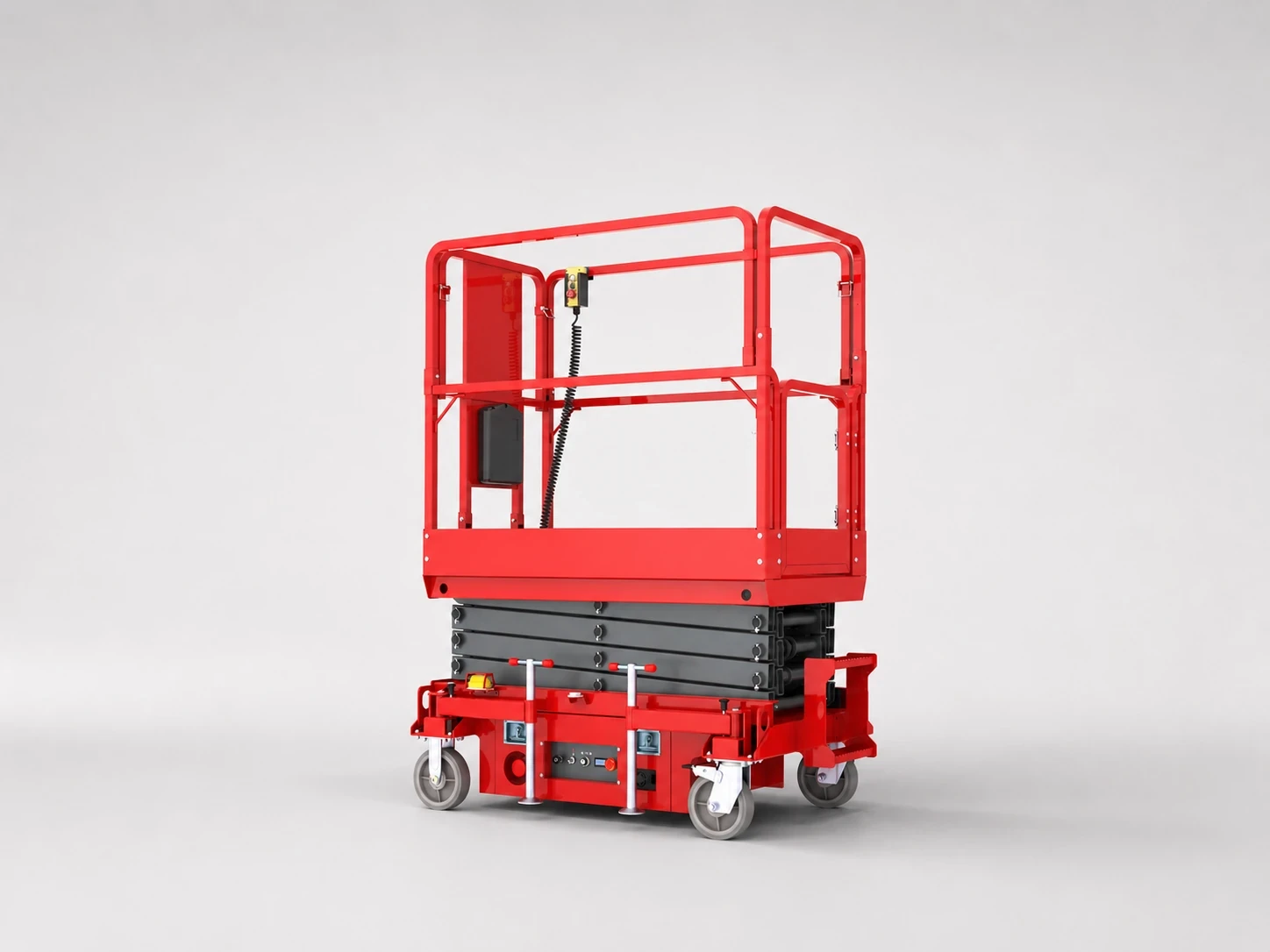
An electric or powered scissor lift provides a stable elevated platform for construction, maintenance, installation, warehousing, and facility work. However, working from an elevated mobile platform introduces hazards that must be controlled through appropriate equipment selection, worksite assessment, operator training, inspection, fall protection, and safe operating procedures.
For U.S. worksites, OSHA requirements are an important reference point. One detail is often misunderstood: OSHA does not have one standalone regulation titled “the scissor lift standard.” For construction, OSHA generally treats scissor lifts as a type of scaffold, so relevant requirements can come from 29 CFR Part 1926, Subpart L, including 1926.451, 1926.452(w), and 1926.454. OSHA has also issued interpretations explaining that scissor lifts are not covered by the aerial-lift provisions of 1926.453.
This guide explains the main OSHA-related requirements and practical safety considerations for scissor lift operators, employers, contractors, rental companies, and equipment buyers.
Important: This article is an educational overview of OSHA requirements relevant to scissor lifts, particularly in construction. It is not legal advice and does not replace the current OSHA regulations, applicable state-plan requirements, the equipment manufacturer's instructions, or site-specific safety procedures.
What Does OSHA Say About Scissor Lifts?
Are Scissor Lifts Considered Aerial Lifts Under OSHA?
OSHA has specifically addressed this question.
Its interpretation explains that the aerial-lift requirements in 29 CFR 1926.453 refer to equipment covered by the applicable ANSI aerial-lift definition. Traditional scissor lifts, including models with platforms that extend beyond the wheelbase, do not fall within those aerial-lift categories. OSHA therefore treats scissor lifts as scaffolds for purposes of the applicable construction requirements.
This distinction is important because employers should not automatically apply every rule written for boom-type aerial lifts to a scissor lift.
Which OSHA Construction Standards Are Relevant?
OSHA's scissor-lift eTool identifies several construction standards that can apply, including:
29 CFR 1926.20(b) — accident prevention responsibilities
29 CFR 1926.21 — safety training and education
29 CFR 1926.451 — general scaffold requirements
29 CFR 1926.452(w) — mobile scaffold requirements
29 CFR 1926.454 — scaffold training requirements
The exact requirements that apply to a particular job depend on the work being performed and the regulatory framework covering that operation.
Why Is Scissor Lift Safety Important?
Common Hazards
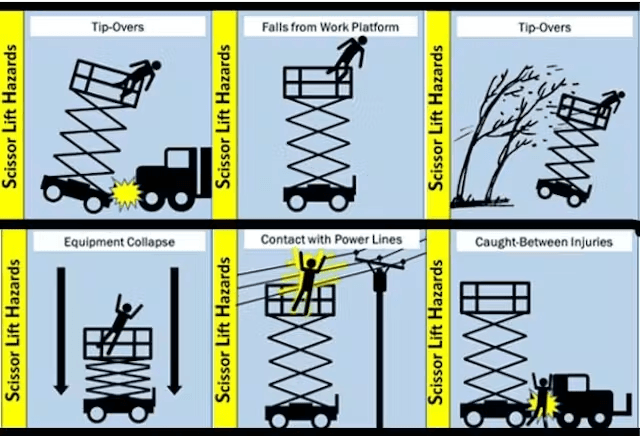
OSHA identifies several major hazards associated with scissor lifts and similar elevated work platforms.
These include:
Falls from the platform
Tip-overs
Collapse or structural failure
Overloading
Falling objects
Crushing hazards
Collision with vehicles or fixed objects
Electrical contact or arcing
Unsafe ground or surface conditions
OSHA's general scaffolding guidance identifies falls, instability or overloading, falling objects, and electrocution as common scaffold hazards, while its scissor-lift guidance specifically discusses falls, crushing hazards, electrical hazards, and worksite positioning.
Why Equipment Selection Matters
Safe operation begins before the machine reaches the jobsite.
Employers need to assess the worksite and select equipment appropriate for the task. OSHA's scissor-lift guidance specifically states that the worksite should be assessed for possible hazards before selecting equipment.
A machine with sufficient working height may still be unsuitable if it is:
Too wide for the access route
Too heavy for the intended surface
Not suitable for the site's ground conditions
Insufficient in load capacity
Unsuitable for the required operating environment
How to Assess a Worksite Before Using a Scissor Lift
Ground and Surface Conditions
Before positioning a scissor lift, evaluate the supporting surface.
Look for:
Holes
Pits
Floor openings
Uneven surfaces
Soft or unstable ground
Slopes
Debris
Other obstructions
OSHA's mobile-scaffold provisions require mobile scaffolds to be properly braced and kept plumb, level, and squared. OSHA's scissor-lift guidance also emphasizes selecting suitable work locations and assessing surface conditions before operation.
A machine should be operated only under conditions permitted by its design and manufacturer's instructions.
Overhead Hazards
Overhead hazards can include:
Structural beams
Door frames
Pipes
HVAC equipment
Lighting systems
Sprinklers
Cable trays
Other fixed structures
OSHA specifically warns about crushing hazards when a moving scissor lift approaches fixed objects or passes beneath structures such as door frames and support beams.
Electrical Hazards
Electrical hazards require particular attention.
OSHA's scissor-lift guidance explains that electricity can arc from a power line to a scissor lift or worker even without direct physical contact. It recommends selecting work locations that do not approach electrical power sources by at least 10 feet and that do not present other overhead hazards.
This should not be treated as the only electrical-safety requirement for every situation. The employer must also comply with the electrical requirements applicable to the specific job.
Scissor Lift Fall Protection Requirements
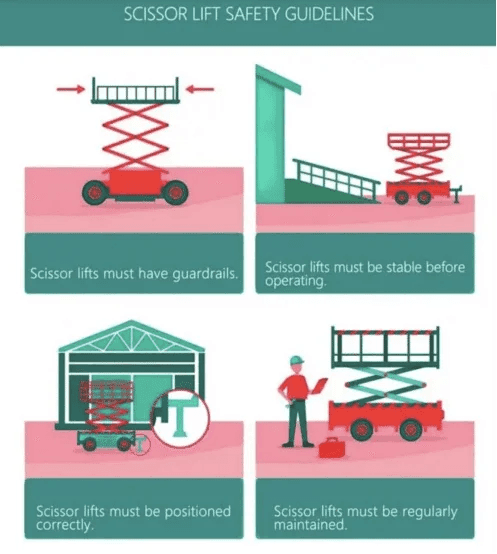
Guardrails
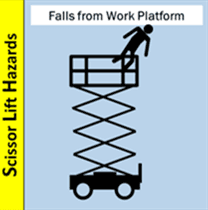
For construction work covered by OSHA's scaffold requirements, employees on scaffolds more than 10 feet (3.1 m) above a lower level must be protected from falling, with the applicable form of protection determined by the scaffold type. For scaffold types not otherwise specified, OSHA 1926.451(g)(1)(vii) requires a personal fall arrest system or a compliant guardrail system.
OSHA's scissor-lift guidance emphasizes maintaining proper guardrails and using the platform as designed.
Can Operators Rely Only on a Guardrail?
OSHA's interpretations recognize properly designed and maintained guardrails as a form of fall protection for scissor lifts in applicable circumstances. Where a guardrail system is inadequate or a worker leaves the protected platform, additional fall protection may be required.
Because fall-protection requirements depend on the equipment, work activity, and applicable standard, employers should not use a generic “harness required” or “harness not required” rule without evaluating the actual situation.
Do Scissor Lift Operators Always Need a Harness?
There is no universally applicable rule saying that every scissor-lift operator must wear a harness in every circumstance.
OSHA's historical interpretations distinguish scissor lifts from aerial lifts and explain that, for the applicable scaffold framework, a properly designed guardrail system can provide required fall protection. Additional personal fall protection can become necessary where the guardrail system is inadequate or the worker is outside the protected platform.
The equipment manufacturer's instructions and the employer's site-specific fall-protection program should also be followed.
Scissor Lift Stability and Positioning
Keep the Equipment Stable
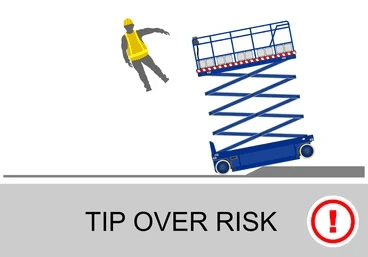
Stability is fundamental to safe scissor-lift operation.
Under OSHA's mobile-scaffold requirements, mobile scaffolds must be properly braced to prevent racking or collapse and must be plumb, level, and squared. Wheels and casters must also be secured against movement when the scaffold is being used in a stationary manner.
These requirements reinforce a basic principle:
An elevated platform must remain within the stability conditions for which it was designed.
Do Not Ignore Site Conditions
Operators should stop and reassess the job when conditions change.
Examples include:
A newly opened floor area
Construction debris entering the travel path
Changes in ground conditions
Vehicles entering the work zone
New overhead obstructions
Weather conditions affecting an outdoor operation
OSHA's general construction requirements place responsibility on employers to establish accident-prevention programs and conduct frequent and regular jobsite, material, and equipment inspections by competent persons.
Scissor Lift Load Capacity and Overloading
Understand Rated Capacity
A scissor lift should never be loaded beyond its rated capacity.
OSHA 1926.451(f)(1) states that a scaffold and its components must not be loaded in excess of their maximum intended loads or rated capacities, whichever is less.
For practical operation, the total platform load should account for:
Operators + tools + equipment + materials
Why Overloading Is Dangerous
Overloading can affect:
Structural components
Stability
Lift performance
Braking and movement
Platform behavior
The risk of tip-over or failure
Operators should use the capacity specified for the exact machine and configuration rather than estimating what appears to be a “safe” additional load.
Scissor Lift Inspection Requirements
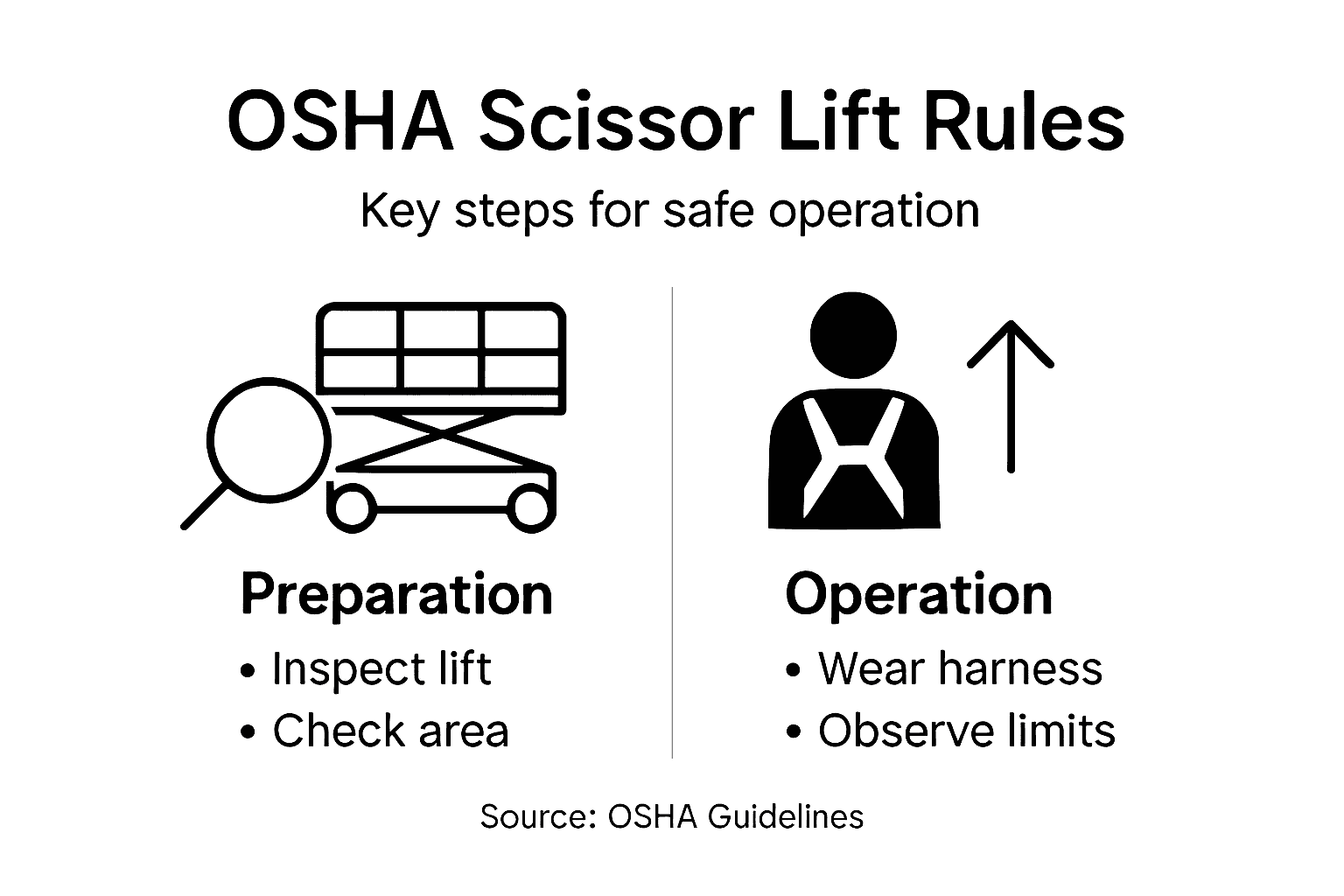
Before Each Work Shift
For construction scaffolds, OSHA requires inspection for visible defects by a competent person before each work shift and after any occurrence that could affect structural integrity. Defective or weakened components must be repaired, replaced, adequately braced, or removed from service until repaired.
This makes pre-operation inspection an essential part of scissor-lift safety.
What Should Be Checked?
A practical equipment inspection can include:
Platform
Guardrails
Access gate
Wheels and tires
Structural components
Hydraulic systems, where fitted
Electrical components
Battery system
Steering
Drive system
Brakes
Controls
Emergency stop
Emergency lowering
Safety alarms and devices
The exact inspection checklist should come from the manufacturer's instructions and the employer's equipment-inspection program.
What Happens When a Defect Is Found?
A defective machine should not simply be operated more cautiously.
OSHA's construction requirements state that equipment that does not comply with an applicable requirement must not be used and should be identified as unsafe, rendered inoperable, or physically removed from the work area as appropriate.
OSHA Scissor Lift Operator Training Requirements
General Training
Under 29 CFR 1926.21(b)(2), employers must instruct employees in recognizing and avoiding unsafe conditions and in the regulations applicable to their work environment.
Scaffold-Specific Training
Because OSHA generally treats scissor lifts as scaffolds in construction, 29 CFR 1926.454 is also relevant.
OSHA requires employees who perform work while on a scaffold to be trained by a person qualified in the subject matter so that they can recognize hazards associated with the type of scaffold being used and understand procedures for controlling or minimizing those hazards. Applicable training includes electrical hazards, fall hazards, falling-object hazards, and other relevant procedures.
Training Should Be Understandable
OSHA has explained that required safety instruction must be presented in a manner employees can understand and should be tailored to the hazards they will encounter.
For international worksites, this makes clear operator manuals, safety labels, training materials, and technical documentation particularly important.
How to Safely Move a Scissor Lift
Check the Travel Route
Before moving the machine, check:
Floor or ground conditions
Holes and openings
Obstructions
Doorways
Overhead structures
Electrical hazards
Pedestrian traffic
Other mobile equipment
OSHA's scissor-lift guidance specifically recommends traffic controls and, where appropriate, ground guides to reduce collision and crushing hazards.
Moving With Workers on the Platform
The conditions under which a worker may ride a mobile scaffold while it is being moved are addressed by OSHA's mobile-scaffold provisions and related guidance. OSHA's guidance discusses surface levelness, pits, holes, obstructions, stability, travel speed, and the worker's position during movement.
Operators should therefore follow the specific equipment manual rather than assuming that every scissor lift can travel in the same way while elevated.
Overhead and Electrical Safety
Maintain Awareness of Fixed Structures
A scissor lift can create crushing hazards when it moves near:
Beams
Door frames
Ceiling structures
Pipes
Machinery
Other fixed objects
OSHA recommends traffic-control measures and ground guides where appropriate to reduce the risk of workers or vehicles getting too close to moving equipment.
Power Lines Require Special Precautions
Operators should identify electrical sources before positioning or moving the equipment.
The danger is not limited to direct contact: OSHA notes that electrical current can arc from a power line to the machine or worker.
The applicable electrical standard and site-specific controls must also be considered.
Prevent Falling Objects
Protect Workers Below
Elevated work can create hazards for people on the ground as well as for platform occupants.
OSHA's scaffold requirements address falling-object protection and identify measures such as toeboards, screens, guardrail systems, debris nets, catch platforms, canopies, and barricading, depending on the hazard. Employees working on scaffolds are also required to use appropriate head protection.
Control Tools and Materials
Operators should avoid allowing tools, components, or materials to accumulate at the platform edge or fall into areas occupied by other workers.
The exact control method should reflect the work activity, platform design, applicable OSHA requirements, and employer procedures.
Can Operators Stand on Scissor Lift Guardrails?
Guardrails Are Not Additional Working Platforms
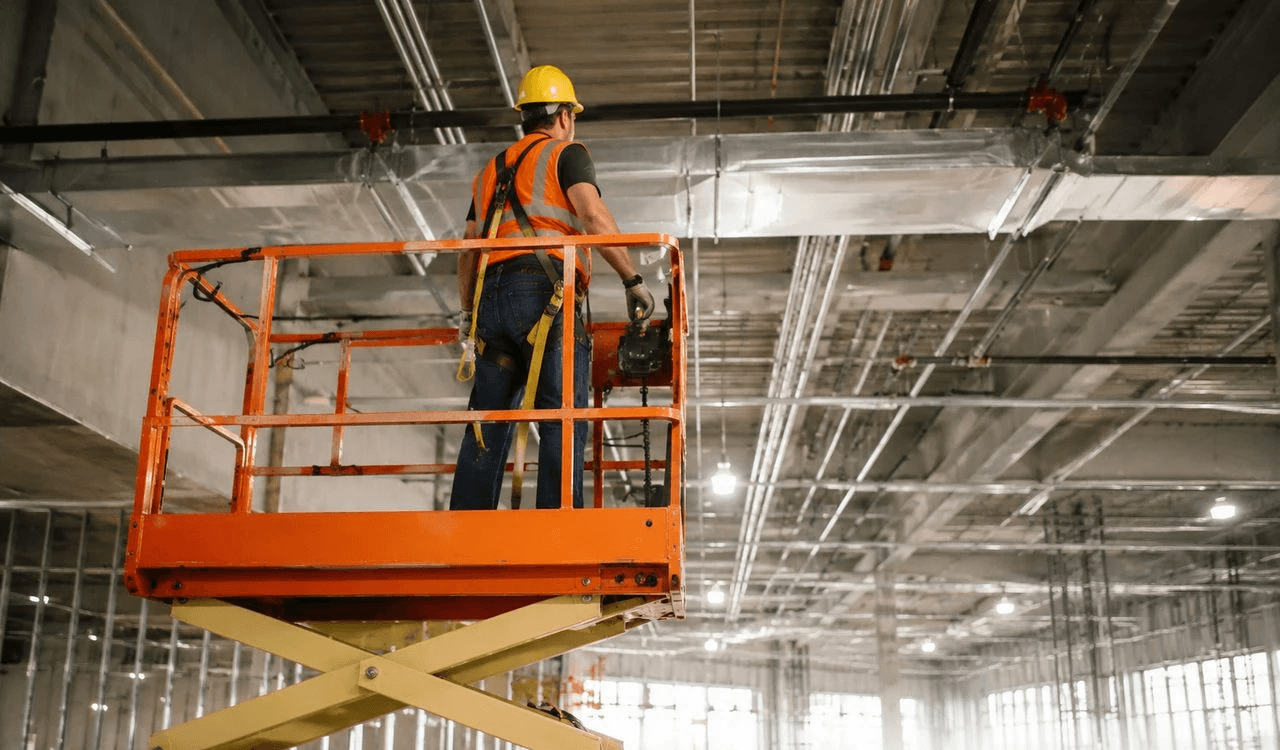
Operators should remain on the designated work platform and should not climb onto guardrails, midrails, or other parts of the platform to gain extra height.
Using boxes, ladders, pallets, or other improvised extensions creates an operating condition that the equipment was not designed for.
Choose the Correct Working Height Instead
If the platform cannot safely reach the required work location, the correct response is to reassess equipment selection.
The required machine should be selected based on:
Working height
Platform height
Load capacity
Platform dimensions
Access width
Operating environment
Manufacturer limitations
This is particularly important when selecting an electric scissor lift for indoor construction, maintenance, or warehouse work.
What Should U.S. Buyers Check Before Purchasing an Electric Scissor Lift?
Working Height and Platform Height
Confirm that the machine can safely reach the actual work point.
Do not select a model solely because its advertised height appears sufficient.
Rated Platform Capacity
Confirm the permitted load and calculate the expected combined weight of operators, tools, equipment, and materials.
Machine Dimensions
Check:
Overall width
Overall height
Lowered height
Platform size
Turning dimensions
Weight
For indoor applications, a compact machine may be more suitable than a larger model with unnecessary reach.
Safety Systems
Depending on the equipment design, buyers may evaluate:
Guardrail system
Emergency stop
Emergency lowering
Braking
Tilt or level-related alarms
Overload protection
Hydraulic protection
Platform controls
Ground controls
The precise configuration should be verified against the manufacturer's specification for the model being purchased.
Documentation
For a U.S. buyer, request the equipment's:
Operator manual
Maintenance information
Safety warnings
Technical specifications
Load information
Inspection instructions
Parts information
Applicable conformity or certification documentation
These documents help employers develop operating and maintenance procedures appropriate for their equipment.
OSHA Compliance Is Not the Same as “OSHA Certification”
Does OSHA Certify Scissor Lifts?
OSHA states that it does not approve, endorse, recommend, or certify commercial products.
This is important terminology for manufacturers and suppliers.
A company should therefore be cautious about marketing language such as:
“OSHA Certified Scissor Lift”
unless there is a specific and properly supported basis for the claim.
The more accurate approach is to identify the applicable regulatory requirements, consensus standards, certifications, tests, and equipment features separately.
What About ANSI Standards?
OSHA's scissor-lift materials reference the ANSI A92 series as relevant consensus standards for manufacturing and operation. OSHA may consider applicable consensus standards when evaluating recognized hazards, but ANSI standards should not simply be represented as OSHA certification.
For B2B buyers, it is therefore better to ask:
Which standards does this model meet, what documentation is available, and which requirements apply to my intended use?
Electric Scissor Lift Safety Checklist
Before Operation
Inspection Item | What to Check |
|---|---|
Operator | Properly trained and authorized |
Manual | Available and understood |
Platform | No visible damage |
Guardrails | Complete and secure |
Access gate | Operating correctly |
Controls | Functioning as intended |
Brakes | Functioning according to manufacturer procedure |
Wheels/Tires | Correct condition |
Battery/Power | Suitable operating condition |
Capacity | Within rated limit |
Ground | Suitable for the equipment |
Overhead area | Hazards identified |
Electrical hazards | Identified and controlled |
Travel path | Clear and suitable |
Work zone | Traffic and pedestrian hazards controlled |
During Operation
Safe Operating Practices
Stay within the designated platform area.
Do not exceed rated capacity.
Do not climb or stand on guardrails.
Do not use improvised height extensions.
Follow the manufacturer's travel and elevation limits.
Maintain awareness of overhead structures.
Maintain separation from electrical hazards.
Monitor pedestrians and nearby equipment.
Stop operation when unsafe conditions develop.
After Operation
Shutdown and Reporting
Follow the manufacturer's instructions for lowering, parking, charging, and securing the machine.
Any defect or abnormal operating condition should be reported according to the employer's procedures. Equipment that is unsafe should be removed from service until appropriately addressed. OSHA's construction rules specifically prohibit use of equipment that does not comply with applicable requirements.
Common Electric Scissor Lift Safety Mistakes
Choosing a Lift Based Only on Height
Working height is important, but capacity, machine width, platform dimensions, ground conditions, and operating environment are equally relevant to the equipment-selection decision.
Exceeding Platform Capacity
The total load includes people, tools, equipment, and materials.
Ignoring Overhead Hazards
A ceiling may look clear from ground level but still contain structural members, pipes, ducts, or electrical hazards.
Operating on Unsuitable Surfaces
A machine that works well on a level indoor floor should not automatically be considered suitable for every outdoor or uneven surface.
Using Guardrails for Extra Height
Standing on or climbing over guardrails changes the intended operating configuration and creates a fall hazard.
Using an Untrained Operator
OSHA's construction standards require appropriate training in hazard recognition and safe procedures.
Ignoring the Manufacturer's Instructions
OSHA compliance does not replace the operating limitations and procedures specified by the equipment manufacturer.
How Manufacturers Can Support Safer Scissor Lift Operation
Provide Clear Technical Documentation
For international B2B buyers, safety support should begin before delivery.
A professional manufacturer should provide documentation covering the machine's relevant:
Specifications
Rated capacity
Operating procedures
Inspection procedures
Maintenance requirements
Safety warnings
Emergency procedures
Parts information
Support Equipment Selection
Manufacturers can also help buyers identify whether a model is appropriate for the intended application.
The buyer should provide:
Required working height
Platform load
Number of operators
Indoor or outdoor application
Access-width limitations
Surface conditions
Required platform size
Operating environment
This information helps the supplier match the equipment to the project rather than simply recommending the highest-capacity model.
Frequently Asked Questions About OSHA Scissor Lift Safety
Does OSHA have a specific standard for scissor lifts?
OSHA does not have one standalone standard titled specifically for scissor lifts. For construction, OSHA generally treats scissor lifts as scaffolds, and relevant requirements can include 29 CFR 1926.451, 1926.452(w), and 1926.454.
Are scissor lifts considered aerial lifts under OSHA?
Generally, no. OSHA has stated that scissor lifts do not fall within the aerial-lift categories addressed by 29 CFR 1926.453 and are instead treated as scaffolds under the applicable construction framework.
Does OSHA require scissor lift operator training?
For construction work, OSHA requires employees to receive instruction concerning unsafe conditions and applicable regulations, while 29 CFR 1926.454 establishes training requirements for employees working on scaffolds.
How often should a scissor lift be inspected?
Under the construction scaffold requirements, scaffolds must be inspected for visible defects by a competent person before each work shift and after an occurrence that could affect structural integrity. Equipment-specific inspection procedures should also follow the manufacturer's instructions.
Do scissor lifts require fall protection?
For construction scaffolds more than 10 feet above a lower level, OSHA requires fall protection appropriate to the applicable scaffold type. For scissor lifts, OSHA's interpretations recognize properly designed guardrail systems as a form of fall protection, with additional personal fall protection potentially required in certain circumstances.
Do scissor lift operators always need a harness?
Not necessarily in every situation. OSHA's scissor-lift interpretations distinguish these machines from aerial lifts and recognize guardrail systems as fall protection where properly designed and maintained. Additional protection may be necessary when the guardrail system is inadequate or a worker leaves the protected platform.
Can you stand on a scissor lift guardrail?
Operators should not stand on or climb over guardrails to gain additional working height. The equipment should be operated within its intended configuration, and a machine with an appropriate working height should be selected for the task.
Can a scissor lift be moved while elevated?
Movement conditions depend on the equipment design, manufacturer instructions, site conditions, and applicable OSHA requirements. OSHA's mobile-scaffold provisions address movement and conditions for riding while moving, including requirements concerning stability and surface conditions.
Does OSHA certify scissor lifts?
No. OSHA states that it does not approve, endorse, recommend, or certify commercial products. Buyers should instead review applicable regulations, standards, certification documentation, manufacturer specifications, and site requirements.
Conclusion
Safe operation of an electric scissor lift in the United States requires a combination of appropriate equipment selection, worksite assessment, operator training, inspection, load control, stability, fall protection, and hazard management.
For construction operations, one of the most important regulatory points is that OSHA generally treats scissor lifts as scaffolds rather than aerial lifts. As a result, employers must consider the applicable construction requirements in OSHA Subpart L, together with general construction safety and training requirements.
For operators, the practical process is straightforward:
Assess the worksite → Select the correct lift → Inspect the equipment → Confirm capacity → Control fall hazards → Identify overhead and electrical hazards → Operate within manufacturer limits → Report defects and maintain the equipment.
For U.S. buyers, safety should also be considered during procurement. Working height, platform capacity, dimensions, machine configuration, operating environment, technical documentation, and after-sales support all affect the suitability of an electric scissor lift.
WIZPLUS can support B2B buyers by providing electric scissor lift solutions matched to the required working height, platform configuration, load requirements, and application. Buyers should always verify the exact specifications and applicable U.S. requirements for the model and jobsite before operation.
For the most authoritative guidance, consult the current OSHA regulations and guidance applicable to your industry, along with the manufacturer's operating and maintenance instructions.