Can an Electric Scissor Lift Go Up a Slope? Understanding Gradeability and Safety Limits
Published
Category
Small Scissor Lift
Learn how electric scissor lift gradeability works, how to calculate slope percentage, and what to check before driving on ramps or inclined surfaces.
Can an electric scissor lift go up a slope?
Yes, some electric scissor lifts can travel on an incline, but only when the specific model is rated for the slope and the operating conditions meet the manufacturer's requirements. Other models may be restricted to firm, level surfaces.
The answer depends on more than the lift's electric drive system. Buyers and operators must consider the machine's gradeability, side-slope rating, permitted operating slope, tire traction, ground conditions, platform position, and rated load.
A scissor lift that can travel up a ramp with its platform fully lowered is not necessarily approved to raise its platform on that ramp. Likewise, a published gradeability rating does not automatically establish that the machine can safely cross every surface with the same calculated slope.
For U.S. contractors, warehouse operators, facility managers, and equipment rental companies, understanding these distinctions is essential when choosing a lift for loading areas, access ramps, parking structures, industrial facilities, and construction sites.
This guide explains what scissor lift gradeability means, how slope percentages are calculated, why uphill and cross-slope travel are different, how to assess a proposed route, and what buyers should verify before purchasing an electric scissor lift.
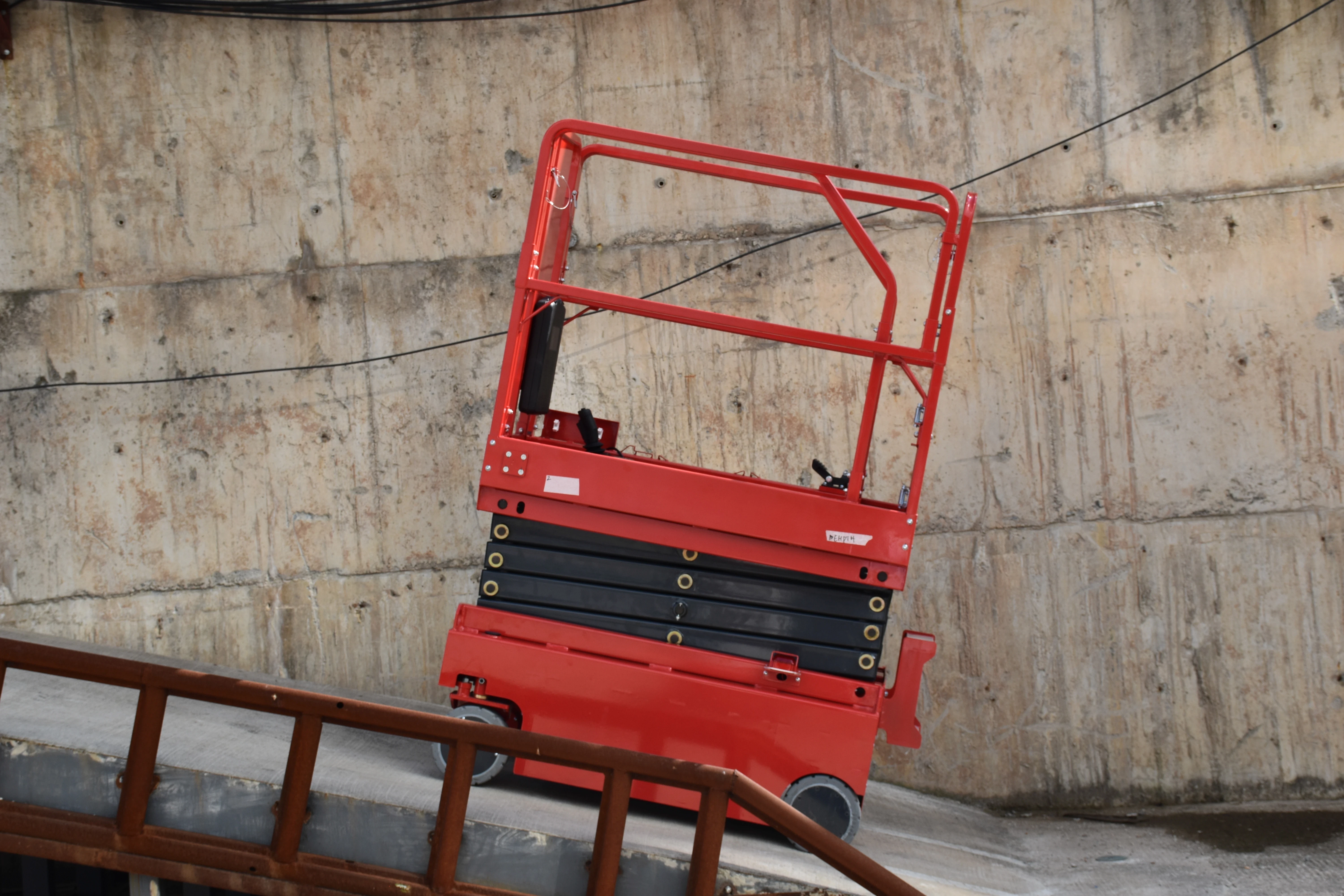
Can an Electric Scissor Lift Go Up a Slope?
An electric scissor lift can travel up or down a slope only if its manufacturer permits that movement under the specific conditions involved.
Some self-propelled scissor lifts have a published slope rating for traveling with the platform in the stowed position. Other models are designed primarily for level indoor surfaces and may have more restrictive operating requirements.
Before driving a lift onto an incline, establish three things:
The machine's documented slope rating: Check the maximum permitted uphill, downhill, and side-slope ratings in the operator's manual.
The platform condition: Determine whether the rating applies only when the platform is fully lowered and the machine is in its stowed configuration.
The actual ground conditions: Confirm that traction, surface firmness, obstacles, load, and other site conditions meet the manufacturer's requirements.
A slope rating is not a general permission to drive anywhere below a stated angle. A wet concrete ramp, an uneven construction surface, and a clean, dry warehouse entrance can present different operating risks even when their measured gradients are similar.
The first step is therefore to identify the exact machine and its operating limits rather than relying on a general rule for all electric scissor lifts.
What Is Scissor Lift Gradeability?
Gradeability describes a machine's ability to travel on an incline under specified conditions. It is commonly expressed as a percentage.
For example, a scissor lift might have a published maximum gradeability of 25%. That figure describes a slope rating under the conditions defined by the manufacturer. It should not be interpreted as permission to elevate the platform on a 25% slope.
Scissor lift manuals may distinguish between maximum uphill grade, maximum downhill grade, and maximum side slope. They may also specify that these ratings apply only when the machine is in its stowed position.

Gradeability vs. Maximum Working Slope
These terms answer different questions.
Technical Term | What It Describes | What Buyers Should Verify |
|---|---|---|
Gradeability | The machine's ability to travel on a specified incline | Whether the rating applies uphill, downhill, or in another direction |
Maximum uphill grade | The permitted uphill travel limit under stated conditions | Platform position, load, traction, and operating restrictions |
Maximum downhill grade | The permitted downhill travel limit under stated conditions | Braking, traction, travel mode, and manufacturer instructions |
Side-slope rating | The permitted inclination across the machine's width during specified travel conditions | Whether cross-slope travel is allowed and under what conditions |
Maximum working slope | The permitted ground inclination for the applicable working or elevated condition, as defined by the manufacturer | The exact definition, platform position, and any level-sensor restrictions |
The terminology and available ratings vary by manufacturer and model. Some manufacturers publish slope ratings only for the stowed condition, while others provide additional model-specific restrictions or operating information.
For example, Genie operator manuals for certain GS slab scissor lift models specify slope and side-slope ratings for the stowed position. The manuals also explain that the ratings depend on ground conditions and adequate traction. These values apply to the models covered by those manuals, not to every scissor lift.
Reference: Genie GS-32 and GS-46 Operator's Manual.
The practical takeaway is simple: use the rating for the exact model and the intended operating state. Do not transfer a slope limit from one manufacturer or model to another.
How to Calculate Scissor Lift Slope Percentage
Scissor lift slope ratings are commonly expressed as a grade percentage (%) or an angle in degrees (°). These measurements describe how steep a ramp is, but they are not interchangeable. Understanding the difference helps equipment buyers evaluate ramps and check whether a scissor lift is suitable for the intended route.
How Is Grade Percentage Calculated?
Grade percentage compares the vertical rise of a ramp with its horizontal distance.
Grade (%) = (Vertical Rise ÷ Horizontal Run) × 100
Vertical rise is the elevation gained, while horizontal run is the horizontal distance covered. The horizontal run is not the distance measured along the sloping surface.
Example: What Does a 25% Grade Mean?
Suppose a ramp rises 2.5 feet over a horizontal distance of 10 feet.
Grade (%) = (2.5 ÷ 10) × 100 = 25%
The ramp therefore has a grade of 25%.
How Do You Convert Grade Percentage to Degrees?
To convert a grade percentage into an angle, use the following formula:
Slope Angle (°) = arctan(Grade (%) ÷ 100)
For a 25% grade:
Slope Angle = arctan(25 ÷ 100) ≈ 14°
This means a 25% grade is approximately 14 degrees, not 25 degrees. A 25-degree slope is significantly steeper, with a grade of approximately 46.6%.
Common Grade Percentage Conversions
Grade Percentage | Approximate Angle |
|---|---|
5% | 2.9° |
10% | 5.7° |
15% | 8.5° |
20% | 11.3° |
25% | 14.0° |
30% | 16.7° |
These figures are mathematical conversions, not recommended operating limits for scissor lifts.
A ramp's calculated grade does not establish that a machine can safely travel on it. The equipment must be rated for the actual conditions, and the manufacturer's instructions remain controlling.
How to Measure a Ramp Before Using a Scissor Lift
For site planning, use a suitable measuring instrument or obtain a reliable measurement from the site team.
Identify the ramp or inclined section that the machine would actually traverse.
Measure its rise and horizontal run, or use an appropriate slope-measuring instrument.
Record the steepest section and any abrupt transitions at the top or bottom.
Determine whether the route also requires cross-slope travel or turning.
Compare the results with the exact model's operating manual.
Do not use an estimated visual angle as the sole basis for deciding whether a ramp is suitable. If the measurements or operating limits are uncertain, do not proceed until the conditions have been evaluated.
Can an Electric Scissor Lift Drive Up a Ramp?
The answer depends on the machine's documented slope rating and the characteristics of the ramp.
Some lifts may be approved for traveling on a specified incline while fully stowed. Others may be intended only for level surfaces. Even when the slope is within the published rating, the ramp must also satisfy the applicable traction, surface, and operating requirements.

Warehouse Entrance Ramps
Warehouse entrances may include sloped approaches, drainage transitions, raised thresholds, and changes between outdoor concrete and indoor flooring.
Before selecting a lift for this environment, check:
The maximum gradient along the intended route.
Whether the ramp is dry, clean, firm, and unobstructed.
The clearance at the top and bottom transitions.
The manufacturer's permitted travel direction and operating state.
The machine's ground clearance and tire configuration.
A lift may meet the numerical slope limit but still be unsuitable if a transition causes the chassis to contact the surface or a wheel to lose adequate traction.
Loading Dock Approaches
Loading areas can involve slopes, dock plates, gaps, height differences, and vehicle movements.
Do not assume that a scissor lift approved for a concrete ramp is also suitable for driving across a dock leveler or bridging plate. These are separate site conditions with their own structural and equipment compatibility requirements.
Confirm the intended route with the equipment manufacturer and the facility's responsible personnel. Keep the lift away from unprotected edges and other loading-area hazards.
Parking Garage Ramps
Parking structures may include curved ramps, changing gradients, drainage surfaces, and turns.
In these conditions, the slope alone is not enough to determine suitability. Cross-slope, turning space, surface traction, overhead clearance, and braking requirements may also matter.
Before using a lift in a parking structure, confirm that the machine is approved for the proposed travel path and that the route can be negotiated within its operating restrictions.
Construction Site Access Routes
Construction sites may contain uneven concrete, loose material, potholes, trenches, temporary ramps, and changing surface conditions.
A general-purpose indoor electric scissor lift should not be assumed suitable for these environments. Some models have strict requirements for firm, level surfaces, while others have specific ratings for travel on inclines.
Select equipment according to the actual ground conditions and the manufacturer's stated application limits.
Can You Raise a Scissor Lift on a Slope?
Do not assume that a scissor lift can be raised on a slope just because it can travel up that slope while stowed.
This distinction is critical because raising the platform changes the machine's configuration and center of gravity. An incline that is permitted for stowed travel may be outside the machine's allowable conditions for elevated work.
OSHA's Scissor Lift Safety Guide advises employers to select firm, level work locations away from hazards such as slopes, holes, bumps, and ground obstructions. OSHA also emphasizes that operators should follow manufacturer instructions for safe movement, which commonly restrict movement while the platform is elevated.
What Happens When the Platform Is Raised?
When the platform rises, the machine's center of gravity moves higher. If the ground is inclined, uneven, soft, or unstable, the combination may increase the risk of instability or tip-over.
Other factors can make the situation more hazardous, including:
Additional weight on the platform.
A wheel entering a hole or depressible surface.
Uneven settlement under the wheels.
Sudden movement or collision.
Wind and other environmental conditions.
Operating beyond the machine's specified limits.
The exact behavior depends on the machine's design and the site conditions. These risks are why manufacturers specify limits for the machine's operating state rather than relying solely on gradeability.
What Should Operators Do?
Before raising the platform, verify that the lift is positioned on a surface permitted by the operator's manual and that all required conditions are met.
If the intended work location does not meet the manufacturer's requirements, reposition the lift on a suitable surface or select equipment designed for the task. Never bypass a tilt alarm, level sensor, interlock, or other safety system to continue operating.
Uphill, Downhill, and Side-Slope Travel: Why the Direction Matters
A slope is not simply a single number. Its orientation relative to the machine can affect the operating conditions.
Uphill Travel
Driving uphill requires the machine to travel against gravity. The permitted gradient depends on the drive system, machine design, traction, load, and conditions specified by the manufacturer.
Check the maximum uphill rating and the stated travel procedure for the exact model.
Downhill Travel
Driving downhill introduces different considerations, including braking and traction.
Do not assume that the downhill rating is identical to the uphill rating. Some manufacturer manuals publish different values for each direction.
Follow the specified travel mode, speed restrictions, and operating procedures. Do not improvise a downhill procedure based on the machine's uphill capability.
Side-Slope Travel
A side slope is an incline across the width of the machine rather than directly in front of or behind it.
Cross-slope conditions can affect stability differently from straight uphill or downhill travel. A machine's side-slope rating may be different from its uphill or downhill rating.
Avoid turning or traversing an incline unless the equipment's instructions expressly permit the proposed movement. When a route involves both a longitudinal slope and a cross-slope, have the complete route assessed rather than considering each measurement in isolation.
What Affects an Electric Scissor Lift's Ability to Climb a Slope?
A published gradeability value is only one part of determining whether a machine is suitable for a particular ramp.
Drive System and Controls
The drive motors, transmission or drive mechanism, braking system, and control logic affect how the machine moves and responds on an incline.
These components must be evaluated as part of the complete equipment design. A higher motor rating alone does not establish that a lift has a higher permitted gradeability.
Tire Traction and Surface Condition
The tires must maintain sufficient traction under the operating conditions specified by the manufacturer.
Wet concrete, oil, dust, loose gravel, mud, and other contaminants may reduce available traction. Damaged or unsuitable tires can also affect the machine's performance.
A slope that appears acceptable when dry may be unsuitable under wet or contaminated conditions.
Machine Load and Load Distribution
The operator, tools, and materials contribute to the total platform load.
Some manufacturer manuals explicitly state that slope ratings depend on the specified conditions and may be reduced by additional platform weight. Therefore, do not assume that a maximum gradeability value applies to every load configuration.
Stay within the rated capacity and follow all restrictions for platform extensions and permitted occupancy.
Ground Clearance and Ramp Transitions
Ground clearance determines how much space exists between the chassis and the surface under specified conditions.
Even a moderate ramp can create a clearance problem where the grade changes abruptly at the entrance or exit. The chassis may contact the transition, or a wheel may encounter a depression or raised obstruction.
Evaluate the full route, including transitions, rather than checking the central ramp alone.
Battery Condition
On a battery-electric scissor lift, battery condition can affect the machine's available operating performance.
However, battery charge alone does not determine safe slope capability. An adequately charged battery does not compensate for unsuitable ground conditions, insufficient traction, or an operating limit that has been exceeded.
Use the manufacturer's battery and operating guidance, and do not attempt to overcome a slope-related restriction by relying on extra battery power.
Electric Scissor Lift vs. Rough-Terrain Scissor Lift
A compact electric scissor lift and a rough-terrain scissor lift may serve different operational needs. Buyers should compare the actual equipment design rather than relying on the product name.
Selection Factor | Compact Electric Scissor Lift | Rough-Terrain Scissor Lift |
|---|---|---|
Typical environment | Suitable indoor facilities and other approved surfaces | Specified outdoor or demanding worksite conditions |
Common considerations | Compact dimensions, floor conditions, charging, and aisle clearance | Tires, ground clearance, surface conditions, drive performance, and outdoor rating |
Ramp suitability | Must be confirmed from the model-specific rating | Must also be confirmed from the model-specific rating |
Elevated operation | Subject to the manufacturer's slope and stability requirements | Subject to the manufacturer's slope and stability requirements |
Best selection approach | Match machine dimensions and ratings to the route and task | Match terrain capability and operating limits to the actual site |
A rough-terrain label does not mean a machine can operate on any gradient or surface. Likewise, not every electric scissor lift is restricted to indoor use. Suitability depends on the specific model's ratings, equipment configuration, and instructions.
If the primary requirement is moving across a sloped or uneven route, verify that the selected machine is designed for those conditions before purchase.
How to Check Whether a Slope Is Safe for Your Scissor Lift
Before allowing a machine to travel on a ramp, use a structured equipment and site review.
Step 1: Identify the Exact Model
Locate the model number and obtain the correct operator's manual and technical specifications.
Do not use limits copied from another model, a similar-looking machine, or a general online article.
Step 2: Check the Slope Ratings
Identify the stated uphill, downhill, and side-slope ratings. Determine whether each rating applies only to the machine in its stowed position.
Check for restrictions concerning platform load, number of occupants, traction, travel direction, and surface conditions.
Step 3: Measure the Actual Route
Measure the slope and identify changes in gradient, turns, cross-slopes, thresholds, and surface defects.
If the route combines multiple slopes or has a complex transition, evaluate the entire path with the site safety team or other qualified personnel.
Step 4: Inspect the Surface
Check for oil, water, loose material, potholes, cracks, raised joints, and other conditions that might affect stability or traction.
A numerical slope measurement cannot make an unsuitable surface safe.
Step 5: Confirm the Permitted Operating State
Verify whether movement is allowed on the proposed slope with the platform stowed, and whether the planned work location meets the permitted conditions for raising the platform.
Never use a travel gradeability figure as a substitute for an elevated working-slope limit.
Step 6: Stop if the Conditions Are Unclear
If the slope exceeds a published limit, the route cannot be assessed reliably, or the manual does not address the intended condition, do not attempt the movement.
Ask the manufacturer for clarification or choose equipment approved for the specific application.
What Should Buyers Check Before Purchasing an Electric Scissor Lift?
For equipment procurement, slope capability should be confirmed before the purchase order is finalized if the machine must travel across ramps or inclines.
Request the following information for the exact model:
Maximum uphill gradeability.
Maximum downhill gradeability.
Maximum side-slope rating.
Whether the ratings apply only in the stowed position.
Any limits relating to platform load or occupants.
Tire type and traction requirements.
Minimum ground clearance.
Permitted surface conditions and slope restrictions.
Instructions for ramp transitions and elevated operation.
The current operator's manual and technical datasheet.
Also explain the intended jobsite to the supplier. Include the approximate slope, whether the incline is straight or curved, the surface material, the required platform height, and whether the machine must stop and perform work near the slope.
A useful technical quotation should identify the relevant model and provide documented specifications rather than a general statement that the lift can climb ramps.
WIZPLUSLIFT Model Verification
WIZPLUSLIFT's public product pages list compact electric scissor lifts, hydraulic-drive and hydraulic-steering configurations, and higher-reach models. For example, the CKJC-EH small electric scissor lift series lists working heights from 5,000 to 6,800 mm across its models.
However, the public specifications referenced for this article do not establish a confirmed gradeability or maximum working-slope rating for every WIZPLUSLIFT model.
Consequently, no universal WIZPLUSLIFT slope percentage should be inferred from the drive motor rating, hydraulic steering system, ground clearance, or working height.
If slope capability is a purchase requirement, ask WIZPLUSLIFT to confirm the exact model's uphill, downhill, side-slope, and operating-state restrictions from the applicable technical documentation before choosing the machine.
Frequently Asked Questions
Can an electric scissor lift go up a ramp?
Some models can travel up or down a ramp within their specified slope ratings and operating conditions. Others may be restricted to level surfaces. Confirm the exact model's operator manual before using a ramp.
What does 25% gradeability mean on a scissor lift?
A 25% grade corresponds to a rise of 25 units for every 100 units of horizontal distance and is approximately 14 degrees. It describes a geometric slope measurement, but safe operating capability must be established from the manufacturer's rating and conditions.
Is gradeability the same as maximum working slope?
No. Gradeability generally refers to travel on an incline under specified conditions. A working-slope limit concerns the conditions in which the equipment may operate, which must be interpreted according to the manufacturer's documentation. A travel rating must not be treated as an elevated working limit.
Can you raise an electric scissor lift on a ramp?
Do not do so unless the exact model's manufacturer instructions permit the intended condition. A rating for stowed travel does not establish permission to raise the platform on an incline.
Can an electric scissor lift travel across a side slope?
Only when the manufacturer permits the specific side-slope condition. Side-slope ratings may differ from uphill and downhill ratings, so all three must be checked when relevant.
Are electric scissor lifts suitable for uneven ground?
Some models may be approved for specified ground conditions, while others are designed primarily for firm, level surfaces. Check the manufacturer's permitted terrain, slope, ground-clearance, and surface requirements.
Does a higher gradeability rating mean a safer scissor lift?
Not by itself. Gradeability is one specification and cannot replace assessment of stability, traction, load, surface condition, braking, and the operating state. Select the machine according to the complete application requirements.
What should I ask a supplier before buying a scissor lift for ramp access?
Request the model-specific uphill, downhill, and side-slope ratings, clarify whether they apply only when stowed, and confirm the permitted load and ground conditions. Provide the actual route and intended work conditions so the supplier can assess suitability.
Conclusion: Verify Gradeability Before Using a Scissor Lift on a Slope
An electric scissor lift may be able to travel on a slope, but the answer depends on the exact machine, its documented gradeability, its operating state, and the conditions of the route.
For safe equipment selection, distinguish uphill and downhill travel from side-slope travel, and distinguish stowed travel from elevated operation. Measure the slope correctly, assess the surface and transitions, and follow the manufacturer's instructions.
For U.S. equipment buyers, gradeability should be treated as a model-specific technical requirement rather than a generic feature of all electric scissor lifts.
WIZPLUSLIFT offers electric scissor lift configurations for different indoor and industrial access applications. Explore the WIZPLUSLIFT electric scissor lift range, and confirm the exact model's documented slope ratings if ramp access is required for your project.