Will a Scissor Lift Fit Through a Door? Dimensions and Clearance Guide
Published
Category
Small Scissor Lift
Will a scissor lift fit through a door? Learn how to measure door width, height, machine dimensions, turning space, elevator access, and clearance before choosing a model.
Will a Scissor Lift Fit Through a Door? Dimensions and Clearance Guide
A scissor lift can fit through a door, but the answer depends on the exact machine dimensions, the doorway's actual clear opening, and the complete access route. Checking the nominal size of the door alone is not enough.
For an indoor electric scissor lift, buyers should compare the machine's overall width, lowered or stowed height, length, platform configuration, and maneuvering space with the actual dimensions of the doorway, corridor, elevator, threshold, and work area.
This is especially important when purchasing a small electric scissor lift for warehouses, factories, commercial buildings, and facility maintenance. WIZPLUS, for example, offers compact electric scissor lift models with overall widths as narrow as 760 mm, while its semi-electric CKJC-Y series ranges from 670 to 810 mm depending on model.
The important question is therefore not simply:
“Is my door a standard size?”
It is:
“Does the exact scissor lift, in its approved transport configuration, fit through the actual clear opening and the entire route to the work area?”
This guide explains how to measure a doorway, which scissor lift dimensions matter, how to evaluate compact electric models, and what buyers should confirm before delivery.
What Determines Whether a Scissor Lift Will Fit Through a Door?

Machine Width Is the First Measurement to Check
For most doorway-access questions, scissor lift width is the first specification to compare.
Measure the doorway's actual clear width, then compare it with the machine's maximum width in the configuration that will be used for transportation.
Do not rely only on:
Door leaf size
Nominal door width
Architectural opening size
Exterior frame dimensions
The useful measurement is the space actually available for the machine to pass through.
For example, WIZPLUS lists the CKJC-EH compact electric scissor lift at 760 mm overall width.
The WIZPLUS CKJC-Y semi-electric series has an overall width of 670–810 mm, depending on the selected configuration.
These figures are useful for initial equipment selection, but they do not by themselves guarantee that a machine can be maneuvered safely through a particular doorway.
Scissor Lift Height Matters When the Machine Is Lowered
A machine may be narrow enough to pass through a door but too tall in its transport configuration.
When checking scissor lift door clearance, compare:
Door clear height
Machine overall height
Lowered height
Folding guardrail height
Guardrail-removed height, where applicable
WIZPLUS publishes these dimensions separately for several models.
For the CKJC-EH series, the overall height is 1,880–2,040 mm, while the listed folding-guardrail height is 1,520–1,680 mm and guardrail-removed height is 1,030–1,160 mm.
The appropriate configuration must always be confirmed against the manufacturer's instructions.
Machine Length Can Affect Entry
Width is not the only dimension involved.
A long machine can fit through a doorway in a straight approach but still have difficulty entering if there is limited space immediately inside or outside the opening.
Check:
Overall length
Doorway depth
Approach distance
Corridor length
Available turning space
WIZPLUS lists the CKJC-EH overall length at 1,410–1,430 mm including pedals, with 1,280 mm excluding pedals.
For a real installation, the exact machine configuration and route should be evaluated together.
What Scissor Lift Dimensions Should You Measure?

Overall Width vs. Clear Door Width
The most basic comparison is:
Door clear width > machine width
But this is a dimensional comparison, not a complete access assessment.
Door hardware, frame geometry, wall projections, protective rails, and the direction from which the lift approaches the doorway can reduce usable space.
Overall Height vs. Clear Door Height
The vertical comparison is:
Door clear height > machine height in the approved transport configuration
A buyer should determine whether the manufacturer specifies:
Lowered machine height
Folding guardrail height
Guardrail-removed height
Other transport configuration dimensions
Do not assume that a guardrail can be folded or removed simply because the machine physically allows it. The procedure must be permitted by the manufacturer.
Overall Length
Measure the machine's length in the configuration used for transport.
Longer machines may require additional room to change direction after entering the building.
Platform Dimensions
Platform dimensions usually do not determine whether the chassis passes through a doorway, but they become important after the machine enters the building.
A machine can fit through the door and still be unsuitable if the platform is too large for the work area.
Wheelbase and Turning Space
Wheelbase and turning space become important when a lift must change direction near the entrance.
WIZPLUS publishes wheelbase data for its models. For example, the CKJC-EH series has a wheelbase of approximately 1,040–1,060 mm depending on configuration.
A doorway should therefore be evaluated as part of a movement path rather than as an isolated opening.
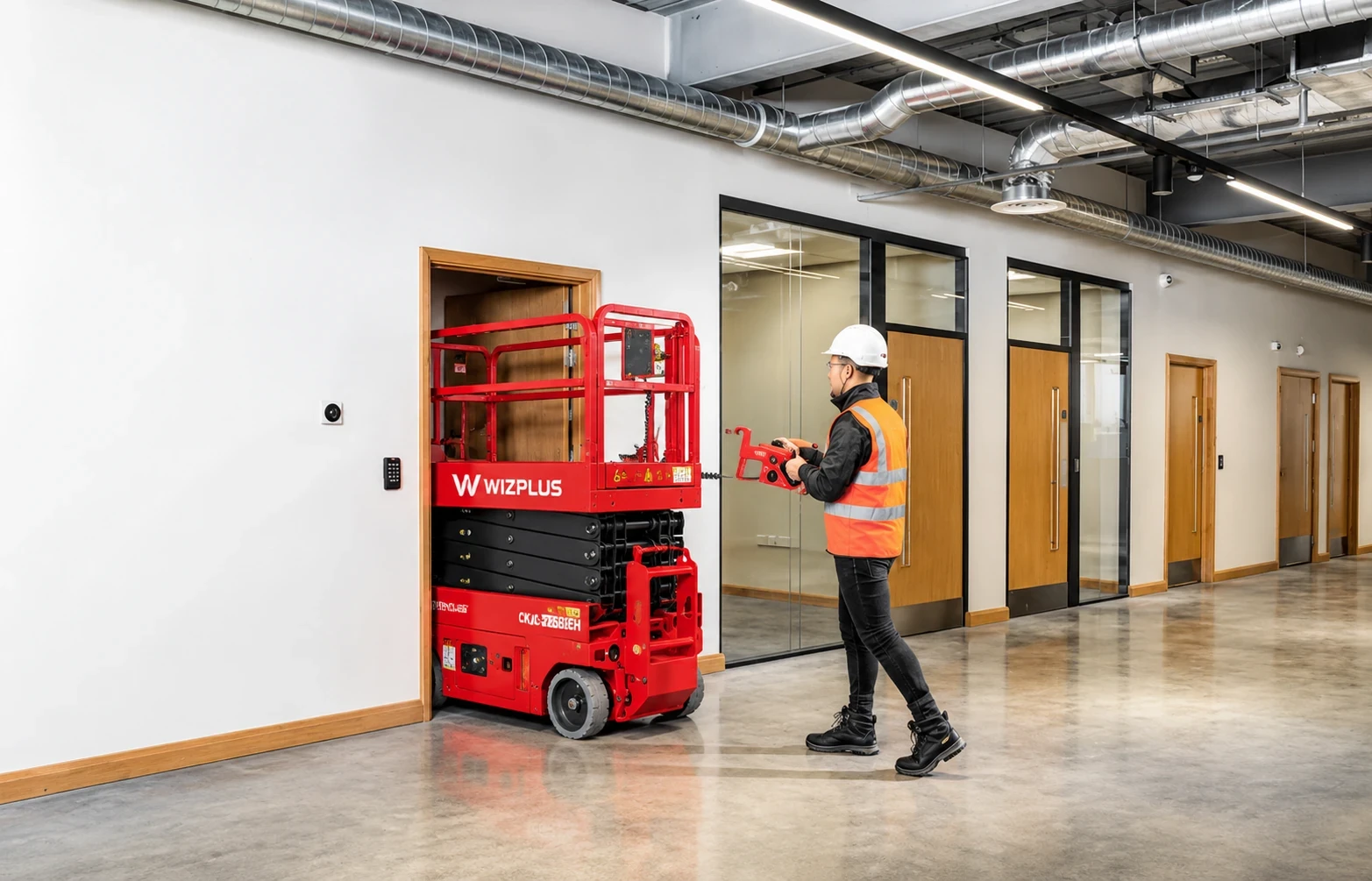
Will a Scissor Lift Fit Through a Standard Door?
There Is No Universal “Standard Door” Answer
The phrase “standard door” is not sufficient for equipment selection because actual clear openings vary by building, door type, frame design, hardware, and installation.
Two doors with the same nominal width can provide different usable openings.
For this reason, a scissor lift buyer should measure the actual doorway at the facility.
Check the Narrowest Point
The machine needs to pass through the narrowest point of the route, not merely the largest opening.
Check:
Door frame
Door hardware
Security devices
Wall projections
Protective barriers
Interior columns
Corridor width
Turns
Example: A Compact Electric Scissor Lift
Suppose a facility has an actual clear doorway width of 900 mm, and the selected WIZPLUS CKJC-EH model has an overall width of 760 mm.
The basic dimensional difference is:
900 mm − 760 mm = 140 mm
That means the machine is narrower than the measured clear opening.
However, 140 mm of dimensional difference does not automatically mean that the machine can be safely driven through the opening at that location. The operator must also consider approach angle, steering, door hardware, surface conditions, and the complete route.
The final access decision should be made using the exact machine specification and site measurements.
How to Measure a Doorway for a Scissor Lift
Step 1: Measure the Clear Door Width
Measure the usable opening with the door in the position in which the machine will pass.
Record:
Clear width = ______ mm
Do not measure only from the outside of one frame to the other.
Step 2: Measure the Clear Door Height
Measure from the finished floor to the lowest overhead point in the opening.
Record:
Clear height = ______ mm
Check for:
Door closers
Tracks
Beams
Pipes
Sprinklers
Other overhead components
Step 3: Measure the Route Immediately Inside the Door
A doorway may lead directly into:
A narrow corridor
A wall
A rack
A structural column
Another doorway
A sharp turn
Measure the space beyond the entrance.
Step 4: Measure the Turning Area
Determine whether the lift can approach, enter, and change direction without contacting structures.
This is particularly important for larger machines and enclosed facilities.
Step 5: Measure Elevator Access Where Required
If the machine must be transported to another floor, measure:
Elevator clear door width
Elevator clear door height
Interior car width
Interior car length
Elevator rated capacity
A lift that fits through the building entrance may still be unsuitable for the elevator.
Step 6: Check the Floor and Threshold
Measure and inspect:
Door thresholds
Ramps
Floor transitions
Surface condition
Uneven areas
The physical dimensions of an opening are only part of the access assessment.
Step 7: Compare the Measurements With the Exact Model
Use the manufacturer's technical data for:
Overall width
Overall height
Lowered height
Folding guardrail height
Guardrail-removed height where applicable
Overall length
Wheelbase
Machine weight
Do not substitute measurements from a similar model.
What Else Should You Check Besides the Door?
Corridors and Aisles
The machine must have enough space to travel after passing through the door.
For warehouse applications, check the narrowest aisle rather than the average aisle width.
A compact chassis can be valuable where racks and fixed equipment restrict movement.
Elevator Dimensions and Capacity
When moving an electric scissor lift between floors, both physical dimensions and elevator capacity matter.
Confirm:
Door opening + elevator interior dimensions + rated elevator capacity
A machine must satisfy all three.
Thresholds and Ramps
Door thresholds can affect movement even when the doorway itself is wide enough.
Check for:
Raised thresholds
Ramps
Gaps
Uneven transitions
The machine's minimum ground clearance and operating limitations should also be considered.
For example, WIZPLUS lists minimum ground clearance of 60 mm for its CKJC-EH models.
Whether that is sufficient for a particular threshold depends on the actual machine and site conditions.
Floor Loading
Machine weight becomes important when transporting a scissor lift through a building or elevator.
The buyer should verify the machine's exact operating or transport weight against applicable floor and elevator limitations.
The correct value must come from the specific model's technical specification.
Overhead Clearance
A machine can fit under the entrance and still encounter a low beam or ceiling structure farther along the route.
OSHA recommends assessing the worksite for hazards before selecting and using a scissor lift, including overhead hazards and conditions affecting equipment positioning.
Do Small Electric Scissor Lifts Fit Through Standard Doors?
Why Compact Width Matters
For indoor maintenance, machine width is often one of the most important specifications.
A compact electric scissor lift can be easier to integrate into:
Warehouses
Factories
Retail facilities
Office buildings
Hotels
Commercial facilities
WIZPLUS's CKJC-EH series has an overall width of 760 mm, while the CKJC-Y semi-electric range covers 670–810 mm depending on model.
Compact Does Not Mean “Fits Everywhere”
Even a narrow electric scissor lift may not fit a particular facility.
The final decision still depends on:
Door opening
Door height
Machine configuration
Turning space
Corridor width
Elevator dimensions
Floor conditions
This is why small electric scissor lift should be treated as a product category, not a guarantee of doorway compatibility.
WIZPLUS Electric Scissor Lift Dimensions for Indoor Access
CKJC-Y Semi-Electric Scissor Lift
The CKJC-Y series includes three configurations.
WIZPLUS lists:
Specification | Published Range |
|---|---|
Maximum safe working height | 5,000–6,800 mm |
Maximum platform height | 3,000–4,800 mm |
Overall width | 670–810 mm |
Overall length, including pedals | 1,410–1,430 mm |
Overall length, excluding pedals | 1,280 mm |
Overall height | 1,780–1,950 mm |
Folding guardrail height | 1,360–1,580 mm |
Guardrail-removed height | 890–1,060 mm |
Wheelbase | 1,110 mm |
Minimum ground clearance | 50 mm |
These are published ranges across different CKJC-Y configurations, not specifications for one individual machine. Buyers should verify the selected model before planning delivery access.
CKJC-EH Small Electric Scissor Lift
For the CKJC-EH series, WIZPLUS lists:
Specification | Published Value / Range |
|---|---|
Maximum safe working height | 5,000–6,800 mm |
Maximum platform height | 3,000–4,800 mm |
Overall width | 760 mm |
Overall length, including pedals | 1,410–1,430 mm |
Overall length, excluding pedals | 1,280 mm |
Overall height | 1,880–2,040 mm |
Folding guardrail height | 1,520–1,680 mm |
Guardrail-removed height | 1,030–1,160 mm |
Wheelbase | 1,040–1,060 mm |
Minimum ground clearance | 60 mm |
The series has four listed configurations and uses hydraulic steering with fully powered travel.
CKJC-7858EH Electric Scissor Lift
For applications requiring more working height, WIZPLUS lists the CKJC-7858EH with:
Specification | Published Value |
|---|---|
Maximum safe working height | 7,800 mm |
Maximum platform height | 5,800 mm |
Overall width | 810 mm |
Overall length, including pedals | 1,840 mm |
Overall length, excluding pedals | 1,690 mm |
Overall height | 2,140 mm |
Guardrails folded | 1,770 mm |
Guardrails removed | 1,300 mm |
Wheelbase | 1,355 mm |
Minimum ground clearance | 100 mm |
Its published safe working load is 300 kg, and its extended platform includes a 900 mm extension section.
The larger machine dimensions demonstrate why buyers should never assume that two electric scissor lifts with similar working-height specifications will have the same access requirements.
How Much Clearance Does a Scissor Lift Need?
Avoid Using a Universal Clearance Number
A common purchasing mistake is to search for one fixed number such as:
“How many millimeters of clearance does a scissor lift need?”
There is no single clearance figure that can safely be applied to every machine and doorway.
The required practical margin depends on:
Machine width
Steering configuration
Approach angle
Door hardware
Surface conditions
Operator visibility
Route geometry
Manufacturer instructions
The correct process is to compare the actual clear opening with the exact machine dimensions, then evaluate the route as a whole.
Dimensional Clearance vs. Operating Clearance
These should be treated differently.
Dimensional clearance asks:
Is the machine physically narrower or shorter than the opening?
Operating clearance asks:
Is there enough practical space to maneuver and control the machine without contacting surrounding structures?
The second question is what matters for real-world access.
Can a Scissor Lift Fit in an Elevator?
Measure More Than the Elevator Door
A scissor lift must usually satisfy several conditions before it can be transported in an elevator.
Check:
Elevator clear door width
Elevator clear door height
Elevator interior width
Elevator interior length
Elevator rated capacity
Machine weight
Machine transport configuration
For example, a lift that is only slightly narrower than the elevator door may still be difficult to position inside the elevator car.
Confirm the Exact Machine Weight
Machine weight varies significantly between models.
WIZPLUS CKJC-EH configurations range from approximately 710 to 820 kg, while the CKJC-7858EH is listed at approximately 1,390 kg.
These figures illustrate why elevator capacity must be checked against the exact model rather than estimated from the machine category.
What Should You Measure Before Ordering a Scissor Lift?
The Pre-Order Measurement Checklist
Before requesting a quotation, collect:
Door clear width
Door clear height
Narrowest corridor width
Turning space
Elevator door width
Elevator door height
Elevator interior dimensions
Elevator rated capacity
Threshold height
Ramp dimensions
Floor conditions
Work area dimensions
Then compare these measurements with the exact machine specification.
Give the Manufacturer the Complete Information
Do not simply tell a supplier:
“I need a 6-meter scissor lift.”
Provide the access information as well.
A useful specification request might include:
Required working height: 6,000 mm
Door clear width: 900 mm
Door clear height: 2,100 mm
Narrowest aisle: 1,200 mm
Elevator capacity: 2,000 kg
Indoor application: Yes
Main tasks: Lighting and facility maintenance
This gives the manufacturer enough information to evaluate both working requirements and access requirements.
A Practical Scissor Lift Access Selection Process
Step 1: Identify the Work Height
Determine the actual height of the work point.
Do not select the machine based only on ceiling height.
Step 2: Measure the Access Route
Measure the narrowest points from the delivery entrance to the final working area.
Step 3: Select Candidate Models
Compare the required working height, load capacity, platform size, and operating environment.
Step 4: Check Transport Dimensions
Compare the selected model's:
Width
Height
Length
Weight
with the measured route.
Step 5: Check Any Special Transport Configuration
If the manufacturer permits folded or removed guardrails for transportation, verify the exact procedure and dimensions.
Step 6: Evaluate Turns and Obstacles
Confirm that the machine can approach and pass the doorway without creating an impractical maneuvering situation.
Step 7: Check Elevators and Floor Conditions
Confirm rated capacity, dimensions, thresholds, ramps, and floor conditions where applicable.
Step 8: Confirm With the Manufacturer Before Shipment
Send the site measurements and exact model number to the manufacturer.
This final confirmation can prevent a machine from arriving at a site where it cannot reach the intended work area.
Common Scissor Lift Doorway Access Mistakes
Measuring Only the Door
The doorway may be wide enough, but a narrow corridor or sharp turn can stop the machine from reaching the work area.
Using Nominal Door Size
A nominal door dimension does not necessarily represent the actual clear opening.
Checking Width but Not Height
A machine can be narrow enough but too tall in its transport configuration.
Ignoring Guardrail Configuration
Some models publish separate dimensions for folded or removed guardrails. Those figures should be used only according to the manufacturer's approved procedure.
Forgetting Elevator Capacity
The machine may fit physically but exceed the elevator's rated capacity.
Ignoring Machine Weight
Weight can affect elevator use, floor loading, transportation, and delivery equipment.
Assuming All Compact Lifts Are the Same
A 760 mm machine and an 810 mm machine may appear similar, but a 50 mm dimensional difference can matter in a restricted access route.
Measuring After Ordering
Access measurements should be completed before purchasing or shipping the machine.
What Does OSHA Say About Scissor Lift Worksite Assessment?
Assess the Worksite Before Selecting Equipment
OSHA's scissor-lift guidance states that employers need to assess the worksite to identify possible hazards in order to select appropriate equipment for the task. OSHA also highlights fall protection, stabilization, positioning, overhead hazards, and electrical hazards in its scissor-lift guidance.
This supports a broader equipment-selection principle:
The machine should be selected for the actual worksite, not just for its advertised specifications.
Doorway Access Is Part of Site Planning
OSHA does not provide a universal “scissor lift doorway width” number.
The doorway, corridor, floor condition, overhead clearance, and surrounding hazards need to be evaluated together with the equipment's capabilities and limitations.
For U.S. construction operations, OSHA's scissor-lift requirements also need to be considered alongside the manufacturer's operating instructions and applicable workplace procedures.
Frequently Asked Questions
Will a scissor lift fit through a door?
A scissor lift can fit through a door when the machine's dimensions in the approved transport configuration are compatible with the doorway's actual clear opening and the complete access route. Width, height, length, turning space, and surrounding obstacles should all be checked before delivery.
What width door does a scissor lift need?
There is no single door width that applies to all scissor lifts. The required doorway depends on the machine's overall width and configuration. WIZPLUS compact electric models include a 760 mm overall-width CKJC-EH configuration, while the CKJC-Y series ranges from 670 to 810 mm.
Will a small electric scissor lift fit through a standard doorway?
It may, depending on the actual clear doorway dimensions and the machine. A compact model can reduce access restrictions, but the exact machine width and transport height still need to be compared with the actual opening.
How wide is a scissor lift?
Scissor lift width varies considerably by model. WIZPLUS lists compact models from 670 to 810 mm overall width across its CKJC-Y and CKJC-EH configurations, while larger CKJC-HD models range from 780 to 1,320 mm.
How tall is a scissor lift when lowered?
Lowered height depends on the model and its configuration. For example, WIZPLUS publishes overall height, folding-guardrail height, and guardrail-removed height separately for its compact CKJC-EH and CKJC-Y models.
Can a scissor lift fit in an elevator?
It depends on the machine dimensions, transport configuration, elevator door and interior dimensions, machine weight, and elevator rated capacity. All of these should be verified before delivery.
How do I measure a doorway for a scissor lift?
Measure the actual clear opening rather than the nominal door size. Record the clear width and height, then measure the corridor, turning areas, thresholds, and elevator access along the complete route.
What is the most important scissor lift dimension for a doorway?
For a straightforward doorway, overall machine width is usually the first dimension to compare. However, overall height, transport configuration, machine length, turning space, and surrounding obstacles also affect whether the machine can actually pass through the route.
Does scissor lift working height determine whether it fits through a door?
No. Working height describes the machine's elevated access capability. Doorway access is primarily determined by dimensions in the transport configuration, including width and lowered height. WIZPLUS's published specifications distinguish working height from overall and lowered transport dimensions.
Should I measure the doorway before ordering a scissor lift?
Yes. Doorway and route measurements should be completed before selecting and shipping the equipment. Providing these measurements to the manufacturer can help confirm whether the selected model is practical for the site.
Conclusion
So, will a scissor lift fit through a door? Sometimes—but the answer must be based on the exact machine and the actual site measurements, not on a generic assumption about standard door sizes.
For indoor equipment selection, start with:
Clear door width → machine width → clear door height → lowered transport height → machine length → turning space → corridor width → elevator dimensions → floor and threshold conditions
A compact electric scissor lift can make indoor access easier, but compact dimensions do not guarantee that every doorway or building route will work.
WIZPLUS provides several compact and electric scissor lift configurations with published dimensions that allow buyers to compare overall width, height, length, guardrail configuration, wheelbase, working height, and machine weight before ordering. The CKJC-EH series, for example, has a published overall width of 760 mm, while the CKJC-Y series offers configurations from 670–810 mm.
Before shipment, give the manufacturer the actual doorway, corridor, elevator, and work-area measurements. That allows equipment selection to be based on the complete access route and actual application, rather than on one headline specification.
For a specific WIZPLUS scissor lift, compare the exact model dimensions with your site measurements and confirm the approved transport configuration with WIZPLUS before delivery.