Blog
What Is a Scissor Lift? How It Works, Types, Uses and Benefits
Published
Category
Scissor Lift
Learn what a scissor lift is, how it works, the main types, common applications, key specifications and how to choose the right lifting platform.
What Is a Scissor Lift?
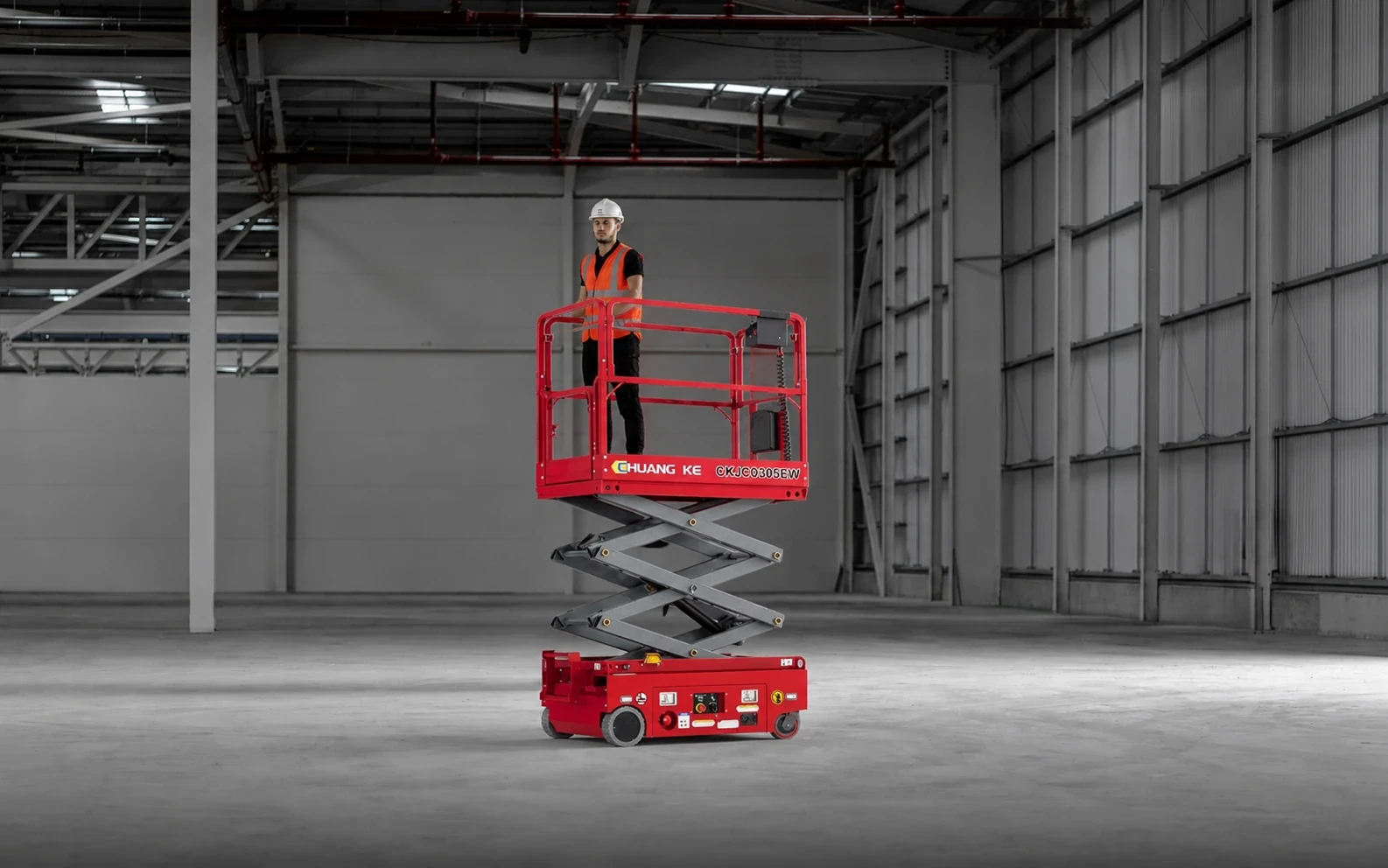
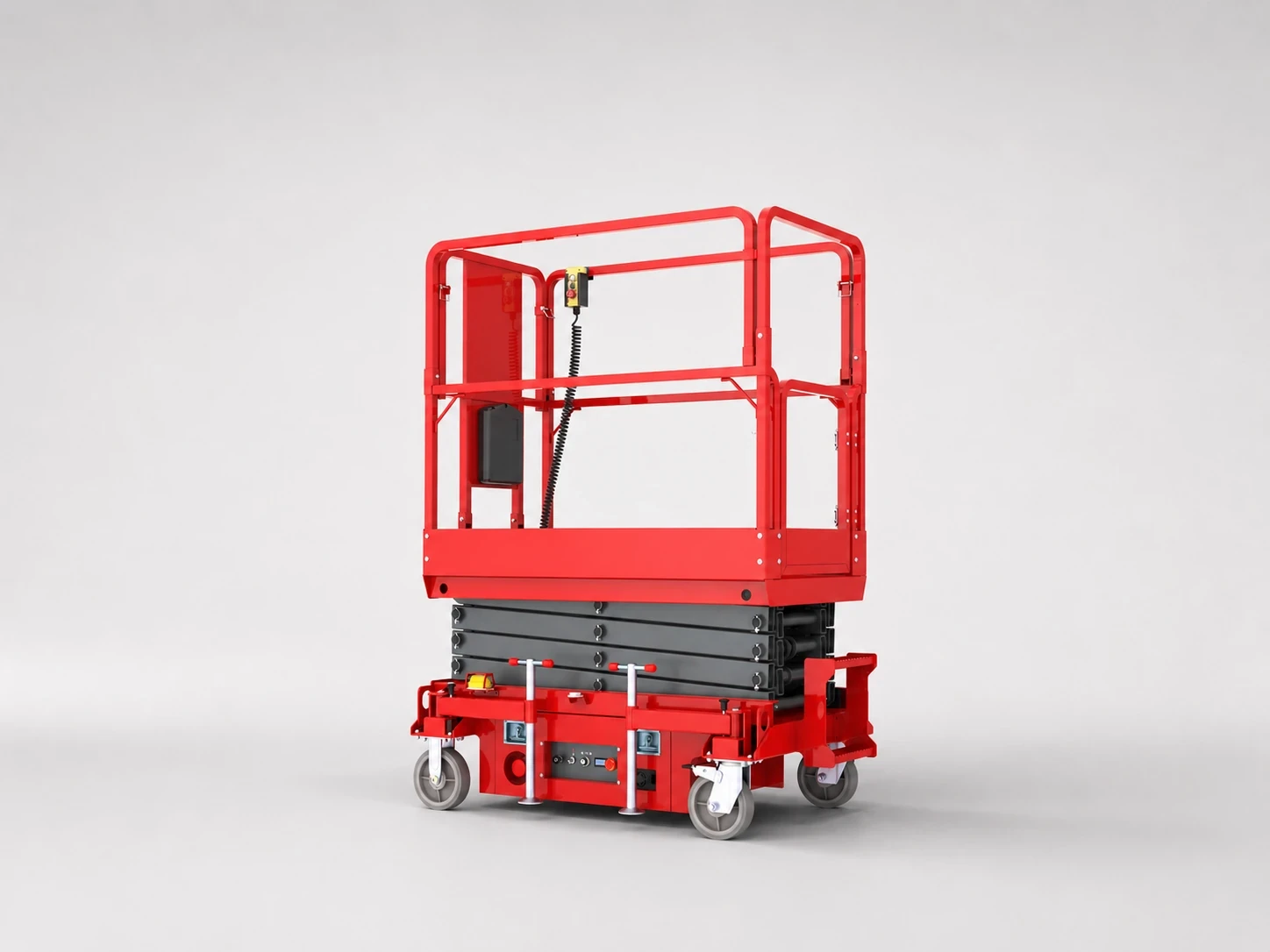
A scissor lift is a type of lifting platform designed to raise people, tools, equipment or materials to an elevated working position. The platform moves vertically through a linked support mechanism that expands and contracts in a pattern similar to a pair of scissors.
Scissor lifts are widely used in warehouses, factories, construction sites, maintenance operations, commercial buildings and other workplaces where workers need temporary access to elevated areas.
Unlike a forklift, which is primarily designed to move and lift materials, a scissor lift is generally designed around providing a stable elevated working platform. This makes it particularly useful for tasks such as maintenance, installation, inspection, inventory access and overhead work.
Different scissor lifts are designed for different environments. Compact electric models may be suitable for indoor facilities, while larger or rough-terrain models can be designed for demanding outdoor applications.
For buyers, the most important point is that a scissor lift should be selected according to the actual working height, load, workspace, floor conditions and frequency of use.
How Does a Scissor Lift Work?
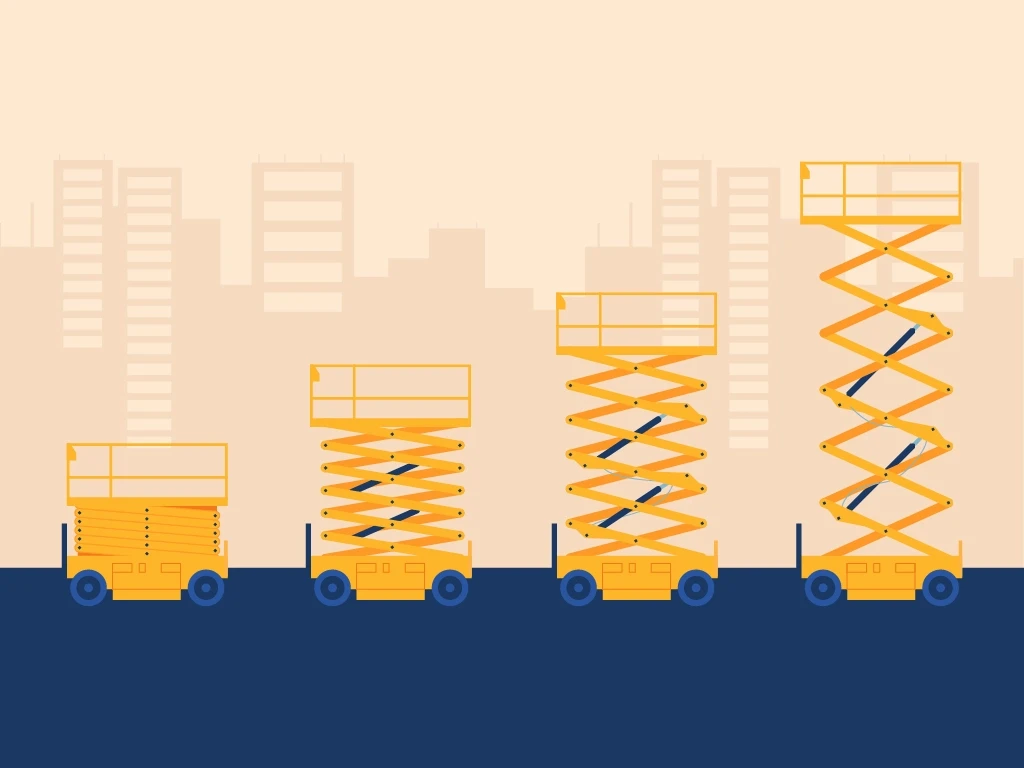
A scissor lift raises its platform through a series of linked supports arranged in an overlapping pattern.
When the lifting mechanism extends, the crossed supports move upward and raise the platform. When the mechanism retracts, the supports fold together and the platform moves downward.
Depending on the model, the lifting mechanism can be powered by different systems.
Electric Scissor Lift
Electric scissor lifts use an electric motor and battery system to power the lifting mechanism. They are commonly considered for indoor applications because battery-powered operation does not require an internal combustion engine during use.
Electric models can be useful in environments such as:
Warehouses
Manufacturing facilities
Shopping centers
Commercial buildings
Indoor maintenance areas
When selecting an electric model, buyers should consider battery capacity, charging requirements, operating hours and the expected lifting cycle.
Semi-Electric Scissor Lift
A semi-electric scissor lift generally combines electrically powered lifting with a simpler movement arrangement. Depending on the specific design, the equipment may require manual positioning rather than fully powered travel.
This configuration can be useful when the primary requirement is elevated access rather than frequent movement across a large facility.
For example, a business may need to raise an operator to a certain height for maintenance or inventory work but only reposition the equipment occasionally.
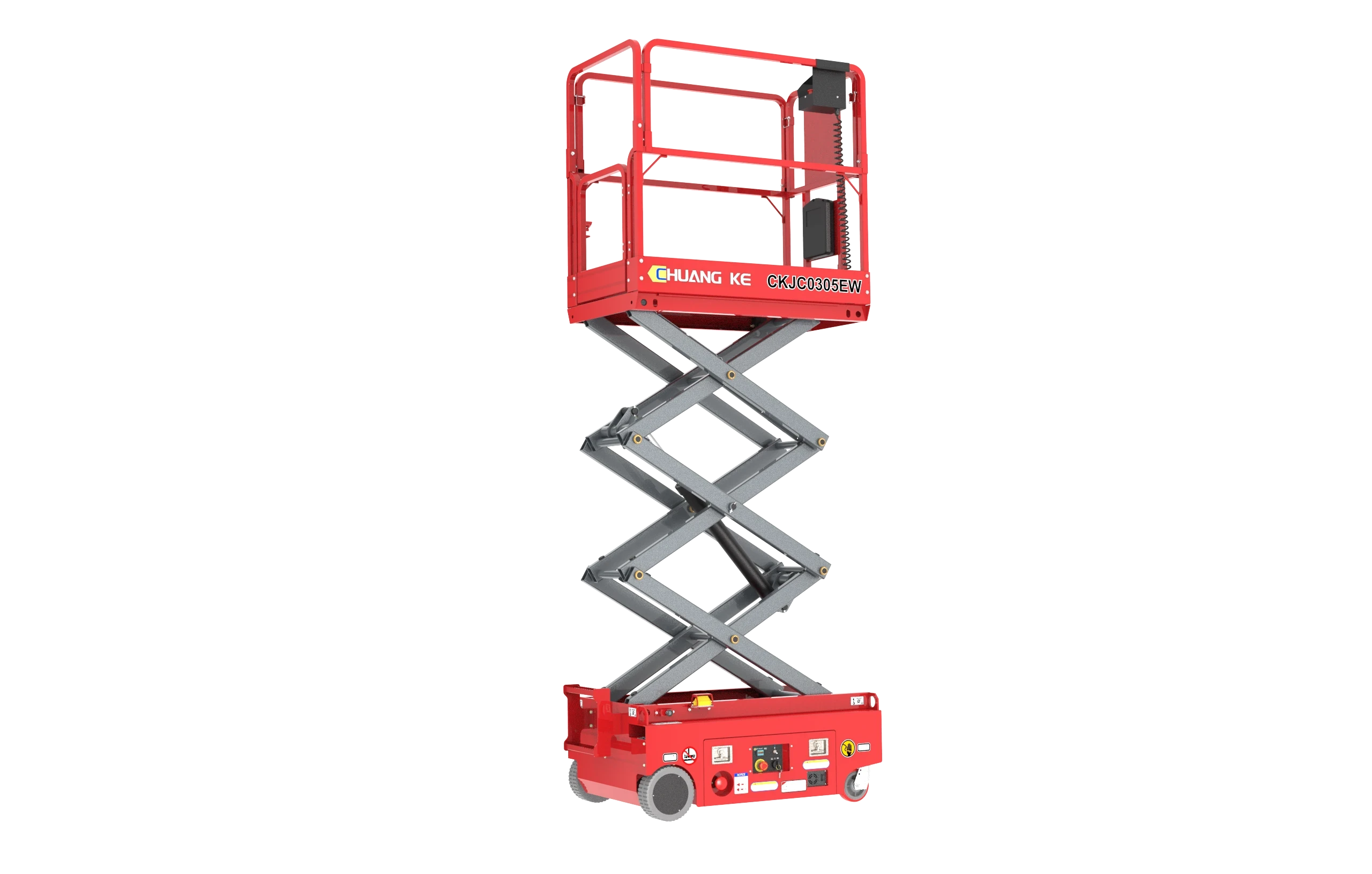
WIZPLUS's CKJC-Y series is an example of a semi-electric scissor lift platform designed for elevated access applications. The series includes different configurations with platform heights and working heights suited to various requirements. Buyers should select the specific model according to their actual working conditions.
Hydraulic Scissor Lift
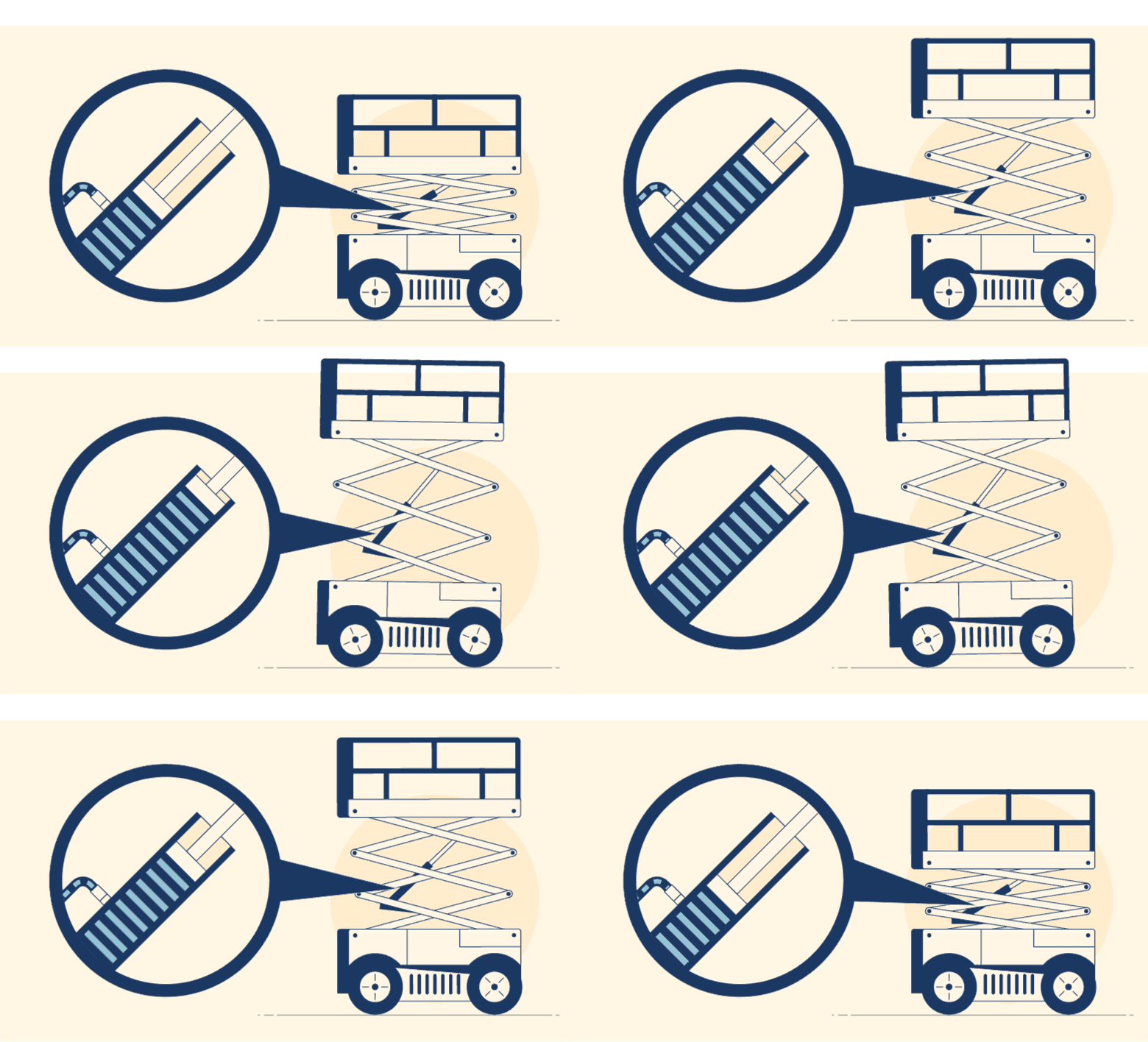
Hydraulic systems use pressurized hydraulic fluid to generate lifting force.
Hydraulic lifting technology is widely used in lifting equipment because it can provide substantial lifting force. However, the suitability of a hydraulic system depends on the machine design, application and operating environment.
Rough Terrain Scissor Lift
Rough-terrain scissor lifts are designed for more demanding outdoor conditions.
They may incorporate features such as:
Larger wheels
Increased ground clearance
Higher load capacity
Stabilizing systems
Outdoor-oriented drive configurations
These machines are generally larger than compact indoor models and should be selected according to the specific terrain and application requirements.
Main Types of Scissor Lifts
Scissor lifts can be classified according to their power system, travel configuration, working environment and intended application.
Electric Scissor Lifts
Electric scissor lifts are powered by batteries and are commonly used for indoor work.
Their potential advantages include:
No direct exhaust emissions during operation
Lower operating noise than combustion-powered equipment
Suitable for indoor environments
Battery-powered operation
However, buyers should confirm that the battery capacity and charging arrangement are suitable for the intended work schedule.
Semi-Electric Scissor Lifts
Semi-electric models provide powered lifting while using a simpler travel configuration.
They can be appropriate when elevated access is required but continuous powered travel is not necessary.
This makes them particularly relevant for applications where the equipment is repositioned relatively infrequently.
Full Electric Scissor Lifts
Full electric scissor lifts use electric power for both lifting and travel.
They can be useful in warehouses and facilities where operators need to move frequently between different working locations.
Compared with semi-electric models, full electric machines may offer greater mobility, but they can also involve a more complex drive system and higher initial investment.
Hydraulic Scissor Lifts
Hydraulic scissor lifts use hydraulic power for lifting.
They can be found in various industrial and mobile lifting applications, with the exact design depending on the machine's intended use.
Rough-Terrain Scissor Lifts
Rough-terrain models are designed for outdoor work and surfaces that may be less controlled than those found inside warehouses or factories.
They should not be selected simply because they offer higher specifications. Buyers should first determine whether the operating environment actually requires this type of equipment.
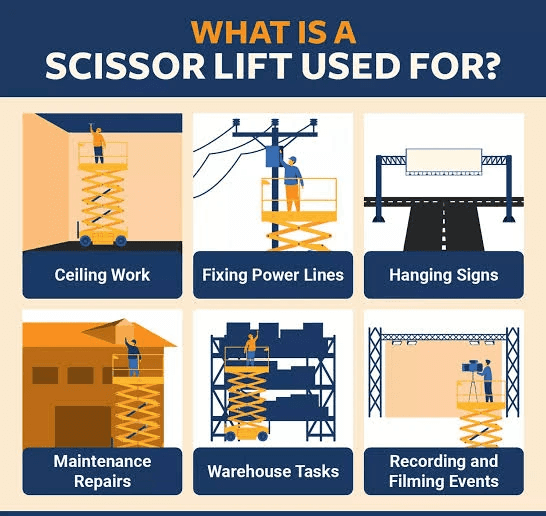
What Is a Scissor Lift Used For?
The main purpose of a scissor lift is to provide a raised working platform.
Instead of repeatedly using ladders, temporary access equipment or other manual methods, an appropriate lifting platform can provide a designated working area at an elevated position.
Common applications include:
Warehouse Operations
In warehouses, scissor lifts can be used for:
Elevated inventory access
Stock checking
Maintenance
Lighting work
Facility inspection
Compact dimensions are particularly important when the equipment needs to operate around storage racks and narrow working areas.
Factory Maintenance
Manufacturing facilities often contain lighting systems, ventilation equipment, electrical installations and other components positioned above normal reach height.
A scissor lift can provide temporary elevated access for suitable maintenance tasks.
Building Maintenance
Commercial and industrial buildings may require regular work on:
Lighting
Ceiling systems
HVAC components
Electrical equipment
Signs and fixtures
The appropriate equipment depends on the working height, load and access conditions.
Installation Work
Scissor lifts can also be used for certain installation tasks where workers need to carry tools or materials to an elevated work position.
The platform capacity should be checked carefully before carrying additional materials.
What Are the Benefits of Using a Scissor Lift?
A properly selected scissor lift can provide several practical advantages.
Stable Elevated Working Platform
One of the main benefits is the ability to provide a dedicated platform for elevated work.
This gives operators a defined working area rather than requiring them to work from improvised access arrangements.
Vertical Access
The scissor mechanism is primarily designed to provide vertical lifting.
This makes scissor lifts particularly useful when the work area is directly above the machine's operating position.
Efficient Access to Elevated Areas
For repetitive maintenance, installation or inventory tasks, a suitable lifting platform can reduce the time required to establish access.
Different Configurations for Different Applications
Scissor lifts are available in different sizes, capacities, working heights and power configurations.
This allows buyers to select equipment based on the actual working environment rather than using one machine for every application.
What Are the Key Scissor Lift Specifications?
Understanding specifications is essential before purchasing a scissor lift.
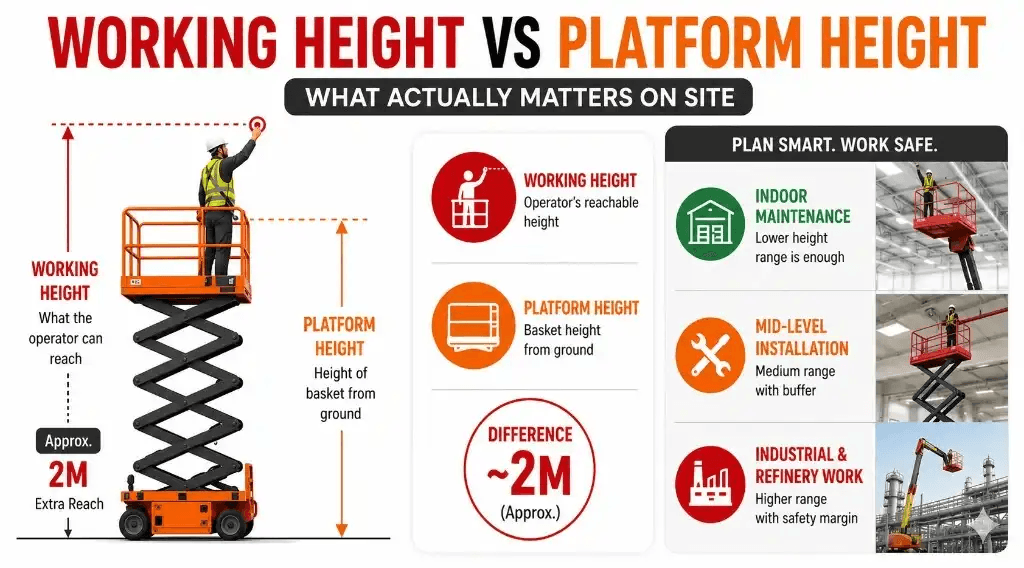
Working Height
Working height indicates the maximum practical height at which an operator can perform the intended task.
It should not automatically be treated as the same measurement as platform height.
Buyers should confirm how the manufacturer defines each measurement.
Platform Height
Platform height refers to the height of the working platform above the ground.
For example, the WIZPLUS CKJC-Y series offers different platform and working heights depending on the selected model.
This is why buyers should compare the exact model specification rather than assuming all scissor lifts provide the same reach.
Load Capacity
Load capacity determines the maximum rated load that the machine is designed to support under specified conditions.
The actual working load may include:
Operator
Tools
Materials
Equipment carried on the platform
The manufacturer's rated capacity should always be followed.
Platform Size
Platform dimensions affect how much space operators have available for tools and materials.
A larger platform may be useful for certain tasks, but it can also increase the machine's overall dimensions.
Overall Dimensions
Overall width and length are especially important for indoor applications.
Before purchasing, measure:
Door openings
Aisle width
Storage areas
Turning spaces
Transportation routes
Battery and Power System
For electric models, battery configuration can influence operating time and charging requirements.
Consider:
Battery capacity
Charging time
Daily operating hours
Number of lifting cycles
Available charging periods
Scissor Lift Working Height vs Platform Height
These two specifications are frequently confused during equipment purchasing.
Platform height describes how high the platform itself can be raised.
Working height refers to the approximate maximum height at which an operator can perform work from the elevated platform.
The exact definition can vary between manufacturers, so buyers should always check the manufacturer's specification.
For example, if a product listing states a platform height of 4 meters and a working height of approximately 5.8 meters, these figures should not be treated as interchangeable.
Understanding the difference helps buyers avoid selecting a machine that does not provide enough practical reach for the intended application.
How to Choose the Right Scissor Lift
Choosing a scissor lift should begin with the work requirement rather than the machine's maximum specification.
Step 1: Determine the Required Working Height
Identify the highest location where work will actually be performed.
Avoid selecting a machine simply because it has the greatest possible height.
Step 2: Calculate the Required Load Capacity
Consider the combined weight of:
Operator
Tools
Materials
Other permitted equipment
Step 3: Measure the Working Area
Check:
Aisle width
Door width
Turning space
Floor conditions
Storage layout
Step 4: Choose the Appropriate Power Configuration
Consider whether you need:
Semi-electric operation
Full electric operation
Hydraulic operation
Rough-terrain capability
The right choice depends on how often the machine moves and where it will operate.
Step 5: Consider Battery Requirements
For electric models, determine whether the machine can support the expected daily operating schedule.
Step 6: Consider Transportation and Storage
International buyers should also consider shipping dimensions, machine weight and storage requirements before ordering.
How Is a Scissor Lift Different From Other Lifting Equipment?
Different lifting machines are designed for different tasks.
Scissor Lift vs Forklift
A forklift is primarily designed for lifting and transporting materials, particularly palletized loads.
A scissor lift is primarily designed to provide an elevated working platform.
If the main requirement is moving pallets, a forklift may be more appropriate.
If the main requirement is raising personnel to an elevated working position, an appropriate access platform may be more suitable.
Scissor Lift vs Boom Lift
A scissor lift generally provides primarily vertical movement.
A boom lift can provide both vertical movement and horizontal outreach depending on the boom configuration.
If the work area is directly above the machine, a scissor lift may be practical.
If workers need to reach over obstacles or access an offset position, a boom lift may be more appropriate.
Scissor Lift vs Scaffolding
Scaffolding provides a temporary elevated work structure, while a scissor lift provides a mobile lifting platform.
The choice depends on:
Work duration
Required mobility
Working height
Site conditions
Frequency of repositioning
What Should You Check Before Buying a Scissor Lift?
Before requesting a quotation, prepare the following information:
Required working height
Platform height
Maximum load
Platform dimensions
Aisle width
Floor conditions
Indoor or outdoor application
Daily operating hours
Travel frequency
Destination country
Required quantity
Providing this information helps manufacturers understand the application and recommend an appropriate configuration.
Common Scissor Lift Buying Mistakes
Choosing Only by Maximum Height
The highest machine is not necessarily the best machine.
Extra height may increase cost, machine size and transportation requirements without providing additional value for the actual application.
Ignoring Machine Width
A machine may meet the required working height but still be unsuitable if it cannot pass through doors or operate in the available aisles.
Confusing Platform Height With Working Height
Always confirm the meaning of each measurement before comparing different suppliers.
Ignoring Battery Requirements
Electric equipment should be matched to the expected operating schedule and charging availability.
Focusing Only on Purchase Price
Compare the complete specification, including:
Capacity
Working height
Battery
Dimensions
Safety systems
Spare parts
Warranty
After-sales support
Frequently Asked Questions
What is a scissor lift used for?
A scissor lift is used to provide elevated access for suitable work tasks such as maintenance, installation, inspection, inventory access and facility work. The appropriate machine depends on the required height, load and working environment.
How does a scissor lift work?
A scissor lift uses interconnected supports that expand and contract to raise and lower the working platform. Depending on the model, the lifting system may be electric, hydraulic or another manufacturer-specific configuration.
What is an electric scissor lift?
An electric scissor lift uses an electric motor and battery system to power the lifting mechanism. Electric models are commonly used for indoor applications where low-noise and battery-powered operation are advantageous.
What is a semi-electric scissor lift?
A semi-electric scissor lift generally uses electric power for lifting while using a simpler movement arrangement. It can be suitable for applications where elevated access is required but frequent powered travel is not necessary.
What is the difference between platform height and working height?
Platform height describes the height of the platform above the ground, while working height represents the approximate height at which the operator can perform work. Buyers should check the manufacturer's definitions when comparing specifications.
How much weight can a scissor lift hold?
The rated capacity varies by model. The permitted load should include the operator, tools and materials carried on the platform, and the manufacturer's rated capacity should never be exceeded.
Are electric scissor lifts suitable for warehouses?
Electric scissor lifts can be suitable for many indoor warehouse applications, particularly where elevated maintenance, inventory access or facility work is required. Machine width, floor conditions, working height and battery requirements should be evaluated before selection.
How do I choose the right scissor lift?
Start by identifying the required working height and load capacity, then evaluate platform size, machine dimensions, aisle width, floor conditions, power configuration, battery requirements and operating frequency.
Is a scissor lift better than a forklift for working at height?
The two machines serve different primary purposes. Forklifts are mainly designed for material handling, while scissor lifts provide an elevated working platform. The appropriate choice depends on whether the task primarily involves moving materials or performing elevated work.
Related WIZPLUS Products
For applications requiring powered lifting with a simpler movement configuration, the WIZPLUS CKJC-Y Semi-Electric Scissor Lift Platform is one option to consider. The series provides different configurations so buyers can match platform height, working height and capacity to their specific application.
Other Blogs