Blog
Order Picker vs Forklift: What’s the Difference and Which One Should You Choose?
Published
Category
Guide
Compare order picker vs forklift for warehouse operations. Learn the differences in picking, pallet handling, lift height, aisle width, safety, applications, cost factors, and how to choose the right equipment.
When comparing order picker vs forklift equipment, the most important question is not which machine is “better.” It is what type of material-handling task your warehouse needs to perform.
A conventional forklift is primarily designed to lift, transport and stack palletized loads. An order picker is designed around a different workflow: bringing the operator to the storage location so individual cartons, products or components can be picked directly from warehouse racks.
That distinction affects everything from aisle width and picking height to load capacity, operator workflow, warehouse layout and equipment cost.
For an e-commerce fulfillment center handling thousands of SKUs, an electric order picker may dramatically improve piece-picking efficiency. For a warehouse receiving and moving complete pallets, a counterbalance forklift may be the more appropriate machine.
This guide explains the differences, applications, limitations and buying considerations so you can choose the right equipment for your operation.
What Is the Difference Between an Order Picker and a Forklift?
The simplest way to understand order picker vs forklift is to look at what happens to the operator and what happens to the load.
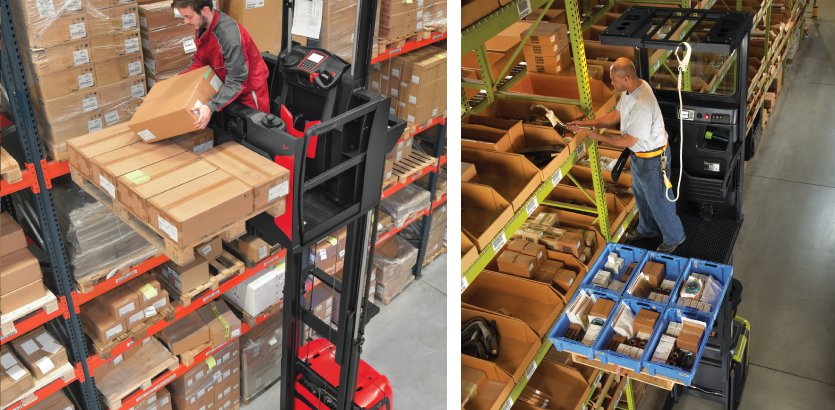
An Order Picker Brings the Operator to the Product
An order picker is specialized warehouse equipment designed for individual-item, case or carton picking.
On medium- and high-level order pickers, the operator platform rises with the operator. This allows the worker to access products stored at elevated rack levels without retrieving the entire pallet.
Typical tasks include:
Picking individual SKUs
Retrieving cartons from shelving
Collecting spare parts
Preparing mixed customer orders
Accessing inventory at multiple rack levels
E-commerce order fulfillment
In U.S. OSHA classifications, order pickers are included among Class II electric motor narrow-aisle trucks.
This category reflects their common use in warehouse aisles and high-density storage environments.
A Forklift Brings the Load to Another Location
A conventional forklift typically uses two forks and a mast to lift a palletized load while the operator remains in the operator compartment.
Typical applications include:
Moving complete pallets
Loading and unloading trucks
Stacking pallets
Moving raw materials
Transporting finished goods
Dock-to-stock operations
Production material handling
Depending on the design, forklifts may use electric motors or internal-combustion engines.
OSHA classifies common powered industrial trucks into several classes. Electric rider trucks fall under Class I, while many internal-combustion forklifts are categorized as Class IV or Class V depending on tire type and configuration.
The practical distinction is simple:
Order picker = operator goes to the individual product.
Forklift = machine moves the palletized load.

How Do Order Pickers and Forklifts Work?
Although both belong to the broader material-handling equipment family, their mechanical layout and workflow are optimized for different tasks.
How an Electric Order Picker Works
A typical electric order picker combines travel, lifting and operator access in one machine.
The basic picking cycle may look like this:
The operator travels to the required warehouse location.
The machine aligns with the target rack position.
The operator platform is raised when elevated picking is required.
The operator retrieves the required carton, component or product.
The item is placed on the machine's load area or pallet.
The operator moves to the next SKU location.
The completed order is transported to packing, staging or dispatch.
This workflow is particularly useful when one customer order contains products stored in several different rack positions.
Commercial order pickers can also be configured for narrow-aisle operation; for example, Toyota describes its order picker as designed for case picking in narrow warehouse aisles, with guidance options available on certain configurations.
How a Counterbalance Forklift Works
A counterbalance forklift uses a weight distribution system that balances the load positioned in front of the machine.
The forks engage a pallet, and the hydraulic mast raises or lowers the load.
The operator typically:
Approaches the pallet.
Inserts the forks beneath it.
Lifts the pallet.
Tilts or positions the load as required.
Travels to another location.
Places the pallet onto the floor, rack, dock or truck.
Counterbalance forklifts are widely used because they can approach many loads directly without the outriggers or base legs found on some other warehouse truck types.
Electric counterbalance models are commonly used in indoor warehousing, while other forklift configurations can serve different environments and duty cycles. Toyota, for example, describes electric counterbalance equipment for warehouse and indoor material-handling applications.
Key Components and Technical Terminology
Understanding the components also helps explain the difference.
An order picker may include:
Operator platform
Mast
Load platform
Forks or load deck
Guardrails
Operator controls
Battery system
Drive motor
Lift motor
Emergency lowering system
Braking system
Guidance system on certain VNA models
A conventional forklift commonly includes:
Forks
Fork carriage
Mast
Counterweight
Hydraulic lift system
Overhead guard
Drive axle
Steering axle
Operator compartment
Battery or combustion powertrain
The components overlap, but their design priorities are different.

Order Picker vs Forklift: Detailed Comparison
For warehouse buyers, the following comparison provides a faster way to understand which machine matches a particular workflow.
Comparison Factor | Order Picker | Conventional Forklift | Best Choice Depends On |
|---|---|---|---|
Primary task | Individual item/carton picking | Pallet transport and stacking | Picking method |
Operator position | Can elevate with platform | Usually remains in cab/compartment | Required product access |
Typical load | Cases, cartons, individual SKUs | Complete pallets | Load format |
Warehouse use | Picking aisles, racks, fulfillment | Docks, staging, production, racks | Workflow |
Aisle requirements | Often suited to narrower aisles | Usually needs more maneuvering space | Layout |
High-level access | Operator accesses inventory directly | Forks lift the pallet | Picking vs pallet retrieval |
Load capacity focus | Picking load + operator/platform requirements | Pallet load capacity | Maximum load |
Power source | Usually electric | Electric, LPG, gasoline or diesel depending on type | Environment |
Main productivity advantage | Efficient SKU and case picking | Efficient pallet movement | Order profile |
Typical buyer | Fulfillment, spare parts, retail distribution | Manufacturing, logistics, warehousing | Application |
Piece Picking vs Pallet Handling
This is one of the most important semantic distinctions in the order picker vs forklift decision.
An order picker is optimized for piece picking or case picking.
For example:
A warehouse employee may need:
2 boxes of Product A
1 carton of Product B
4 units of Product C
3 components of Product D
Those items may be stored in four different vertical rack positions.
An order picker allows the employee to access each location directly.
A forklift is usually more efficient when the warehouse needs to move:
one complete pallet of Product A from receiving to rack location 05-12.
Operator Elevation vs Load Elevation
With a high-level order picker, the operator and picking platform rise.
With a conventional forklift, the load rises while the operator remains in the driving position.
This distinction has important implications for:
Safety procedures
Operator training
Fall protection
Warehouse layout
Travel speed
Productivity
Storage strategy
OSHA specifically identifies elevated order-picking operations as requiring attention to fall hazards and applicable fall-protection requirements.
Narrow Aisle Performance and Storage Density
Warehouse operators often want to increase the amount of inventory stored within the same building.
One strategy is to:
reduce aisle width + increase rack height + improve vertical storage utilization.
Order pickers are frequently associated with narrow aisle and very narrow aisle (VNA) environments.
However, narrow-aisle suitability must never be assumed from the equipment name alone.
Buyers should verify:
Overall machine width
Turning radius
Right-angle stacking requirement where relevant
Load dimensions
Clear aisle width
Rack protection clearance
Cross-aisle space
Guidance requirements
Floor condition
An improperly matched truck can create both productivity and safety problems even if its nominal width appears suitable.
How to Choose Between an Order Picker and a Forklift
The correct decision should be made from the warehouse process backward—not from the equipment catalog forward.
Which Machine Is Better for Different Warehouse Applications?
E-Commerce Fulfillment Centers
For e-commerce warehouses, an order picker is often the more specialized option when employees need to retrieve individual SKUs from multiple rack positions.
Typical requirements include:
High SKU count
Mixed orders
Frequent picking cycles
Multiple rack levels
Short order-processing times
A forklift may still be required for inbound pallet handling, replenishment and outbound pallet movement.
In many fulfillment centers, therefore, the answer is not order picker or forklift.
It is:
order picker + forklift, each assigned to the job it performs best.
Manufacturing Facilities
Manufacturing plants often move:
Raw material pallets
Finished goods
Heavy components
Packaging materials
Production supplies
A forklift may therefore be the primary material-handling truck.
However, if a spare-parts warehouse contains thousands of individual maintenance components, an order picker may still be useful in the same facility.
Spare-Parts Warehouses
Automotive, machinery and industrial spare-parts warehouses are strong applications for warehouse order pickers.
A single facility may contain thousands or tens of thousands of SKUs, but only a few units of each part may be required for one order.
Direct access to individual storage positions becomes more valuable than moving full pallets.
Logistics and Distribution Centers
Distribution centers frequently require both equipment types.
Forklifts may handle:
Receiving
Pallet unloading
Staging
Replenishment
Dispatch
Order pickers may handle:
Case picking
Mixed orders
SKU retrieval
Store replenishment orders
E-commerce orders
A 7-Step Equipment Selection Process
Before purchasing either machine, use this decision sequence:
Define the load format.
Determine whether you mainly move complete pallets or pick individual items.Measure the maximum required height.
Identify pallet lift height and operator picking height separately.Measure every critical aisle dimension.
Do not rely only on architectural drawings; measure the actual operating space.Calculate the maximum realistic load.
Include the pallet, goods, attachments and other relevant operating conditions.Analyze travel and picking frequency.
Compare occasional use with continuous multi-shift operations.Evaluate the operating environment.
Consider indoor/outdoor use, floor quality, slopes, temperature and charging infrastructure.Send the application data to the manufacturer.
Equipment selection should be based on real warehouse conditions rather than only price or nominal lift height.
The Most Important Specifications to Compare
When requesting a quotation, buyers should compare:
Rated load capacity
Load center
Maximum lift height
Maximum picking/platform height
Overall machine width
Turning radius
Minimum aisle requirement
Mast lowered height
Battery voltage and capacity
Battery chemistry
Travel speed
Lift speed
Gradeability where relevant
Machine weight
Charger specification
Safety configuration
Spare-parts availability
Do not compare two machines using only price + maximum height.
That is rarely enough information for a professional buying decision.
Safety, Load Capacity and Industrial Truck Standards
Safety is a critical part of comparing an order picker with a forklift because the risk profile changes when an operator is elevated.
Rated Capacity, Load Center and Stability
A forklift's rated capacity is not simply a universal maximum weight.
Load position matters.
Moving the center of gravity farther forward can reduce the machine's safe lifting capacity.
OSHA specifically notes that load size, position and weight distribution affect truck capacity and stability, and operators should use the truck's data plate to determine allowable capacity under the relevant load-center conditions.
This is why professional buyers should examine:
rated capacity + load center + lift height + attachment configuration
rather than simply asking:
“How many kilograms can this forklift lift?”
Attachments can also change stability, capacity and visibility characteristics.
Operator Training and Daily Inspection
Both forklifts and powered order pickers require appropriate operator training under applicable workplace regulations.
In the United States, OSHA's Powered Industrial Truck requirements cover subjects including:
Truck controls
Steering
Maneuvering
Vehicle capacity
Stability
Load handling
Attachments
Battery charging or refueling
Workplace hazards
Inspection and maintenance responsibilities
Equipment should also be inspected according to the manufacturer's instructions and applicable workplace requirements.
OSHA provides sample daily inspection checklists while emphasizing that checklists should be adapted to the actual truck and manufacturer recommendations.
OSHA, ANSI/ITSDF and ISO Standards
For buyers comparing order picker vs forklift equipment internationally, safety and compliance requirements depend on the destination country and machine configuration.
Relevant entities may include:
OSHA 29 CFR 1910.178
U.S. workplace requirements covering powered industrial trucks.
ANSI/ITSDF B56.1
A safety standard covering design, operation and maintenance requirements for low-lift and high-lift powered industrial trucks.
ISO 3691 Series
International standards covering safety requirements and verification for industrial trucks. ISO currently lists ISO 3691-1:2011 with Amendment 1:2020, while a successor edition is under development.
ISO 3691-3
Addresses additional requirements relevant to trucks with elevating operator positions and certain trucks designed to travel with elevated loads; ISO lists Amendment 1:2023 for this standard.
Applicable standards and editions can change.
Always verify the requirements for the destination market and the exact equipment configuration before ordering or placing machinery into service.
Common Mistakes When Choosing an Order Picker or Forklift
Buying warehouse equipment based on a single specification is one of the easiest ways to select the wrong machine.
Mistake 1: Choosing by Maximum Lift Height Alone
A buyer may say:
“I need an 8-meter machine.”
But that does not explain:
Rack height
Required operator position
Load height
Platform height
Working height
Mast constraints
Ceiling clearance
For an order picker, picking height may matter more than fork elevation alone.
For a forklift, rated capacity at the required lift height may be critical.
Those are different engineering questions.
Mistake 2: Ignoring Aisle Width and Turning Space
A machine may physically fit between two racks but still be unable to operate efficiently.
Buyers should evaluate:
Clear rack-to-rack distance
Turning geometry
Pallet length
Load overhang
Cross aisles
Columns
Rack protection
Pedestrian traffic
This is especially important when considering a narrow aisle order picker.
Mistake 3: Comparing Rated Capacity Without Checking Load Center
Two forklifts advertised with the same nominal capacity may not perform identically under different loads, lift heights or attachment configurations.
OSHA guidance emphasizes that load-center position and weight distribution directly affect capacity and truck stability.
Always request the relevant capacity information and data plate configuration for your actual application.
Mistake 4: Assuming One Machine Can Efficiently Do Everything
Technically possible does not always mean operationally efficient.
A conventional forklift may be able to assist with certain picking tasks, but that does not automatically make it the best machine for high-frequency individual SKU picking.
Likewise, an order picker should not automatically be treated as a replacement for a forklift used to transport heavy palletized loads.
The better question is:
Which machine reduces unnecessary movements in this specific workflow?
Troubleshooting Poor Warehouse Productivity
If your existing equipment feels slow, the problem may not simply be the truck.
Check whether:
Operators travel excessive distances
Fast-moving SKUs are stored too far apart
Picking routes are poorly designed
Aisles are congested
Pallet and piece-picking workflows overlap
Battery charging interrupts shifts
Equipment does not match rack height
Replenishment happens during peak picking
Warehouse Management System data does not support efficient pick paths
This leads to an important insight:
Equipment selection and warehouse layout should be optimized together.
A better machine cannot completely compensate for a poor warehouse process.
Frequently Asked Questions About Order Picker vs Forklift
What Is the Main Difference Between an Order Picker and a Forklift?
The main difference is the task.
An order picker is designed to help an operator retrieve individual products or cartons from storage locations.
A conventional forklift is primarily designed to lift and transport palletized loads.
For high-level order picking, the operator may rise with the order-picker platform. On a traditional forklift, the operator generally remains in the driving position while the forks raise the load.
Can an Order Picker Replace a Forklift?
Not in every application.
An order picker may replace a forklift for certain piece-picking or case-picking activities, but it is generally not a universal replacement for pallet-handling equipment.
If your warehouse receives, stacks and transports complete pallets, a forklift or another pallet-handling truck may still be required.
Many warehouses benefit from using both machines for separate stages of the material flow.
Is an Order Picker a Type of Forklift?
The terminology varies by market, which is why phrases such as order picker forklift are commonly used.
More precisely, both machines belong to the broader powered industrial truck and material-handling equipment family.
OSHA includes order pickers within its Class II electric motor narrow-aisle truck classification.
Therefore, calling an order picker a specialized type of warehouse lift truck is generally more useful than treating it as identical to a conventional counterbalance forklift.
Which Is Better for a Warehouse: Order Picker or Forklift?
It depends on the warehouse process.
Choose an order picker when the primary requirement is:
Individual SKU picking
Carton picking
Elevated shelf access
Mixed-order fulfillment
High-density warehouse picking
Choose a forklift when the primary requirement is:
Pallet transportation
Truck loading/unloading
Pallet stacking
Production material movement
Heavy unit-load handling
For mixed warehouse operations, using both can provide the most efficient workflow.
Conclusion: Order Picker vs Forklift — Which One Is Right for You?
The Decision Comes Down to Your Material Flow
The order picker vs forklift decision should not begin with machine price.
It should begin with the movement of goods inside your warehouse.
If your operation mainly handles individual cartons, components and mixed-SKU orders, an electric warehouse order picker may provide the more specialized workflow.
If your operation mainly moves complete pallets, heavy loads and unitized goods, a conventional forklift is usually the more appropriate starting point.
For many modern warehouses, the optimal solution is a combination:
Forklift for pallet movement → Order picker for individual order fulfillment.
Before purchasing either machine, evaluate:
load type + picking height + rated capacity + aisle width + rack layout + travel distance + duty cycle + battery requirements + operating environment + local compliance requirements.
That produces a much more accurate equipment decision than comparing specifications in isolation.
Talk to WIZPLUS About Your Warehouse Application
WIZPLUS supplies order picking and lifting equipment for warehouse and material-handling applications.
If you are not sure whether your operation requires an electric order picker, warehouse order picker, forklift-related solution or another type of lifting equipment, send us your application information.
Contact WIZPLUS today to discuss the right material-handling solution for your warehouse.
Other Blogs